15 Best Outdoor Lights for Homes in 2026: Ideas & Tips
The best outdoor lights for homes in 2026 include LED wall lights, floodlights, garden lights, solar lights, pathway lights, and motion sensor lights. Choose weather-resistant fixtures with suitable IP ratings, energy-efficient LEDs, and the right brightness to improve your home's exterior appearance, safety, and functionality.
₹289
LED outdoor wall light, Fybros 10W
₹1,009
Up-and-down outdoor wall light, 6W
The right outdoor lighting can transform the appearance of your home after sunset. From an elegant entrance and a beautifully illuminated balcony to a welcoming garden and a well-lit driveway, outdoor lights improve the look and functionality of your exterior spaces.
Choosing the best outdoor lights involves more than selecting an attractive design. You also need to consider brightness, weather resistance, energy efficiency, colour temperature, installation position and maintenance requirements. A decorative light that looks beautiful but cannot withstand heavy rain may not be the right choice for an exposed outdoor area.
In India, outdoor lighting must withstand changing weather conditions, including monsoon rain, heat, dust and humidity. Modern LED fixtures, outdoor wall lamps, landscape lights and solar-powered options offer practical solutions for different home styles and budgets.
Whether you live in an apartment, an independent house, a villa or a duplex, the right combination of lighting can make your exterior more attractive and comfortable.
In this guide, we explore 15 outdoor lighting ideas for 2026, explain where each type works best and share practical tips to help you choose suitable fixtures for your home.
What Are the Best Outdoor Lights for Homes in 2026?
The best outdoor lights depend on the area you want to illuminate and the effect you want to create. Outdoor wall lights work well near entrances, LED floodlights provide broad illumination, and garden lights highlight plants and pathways.
Here are 15 popular options to consider:
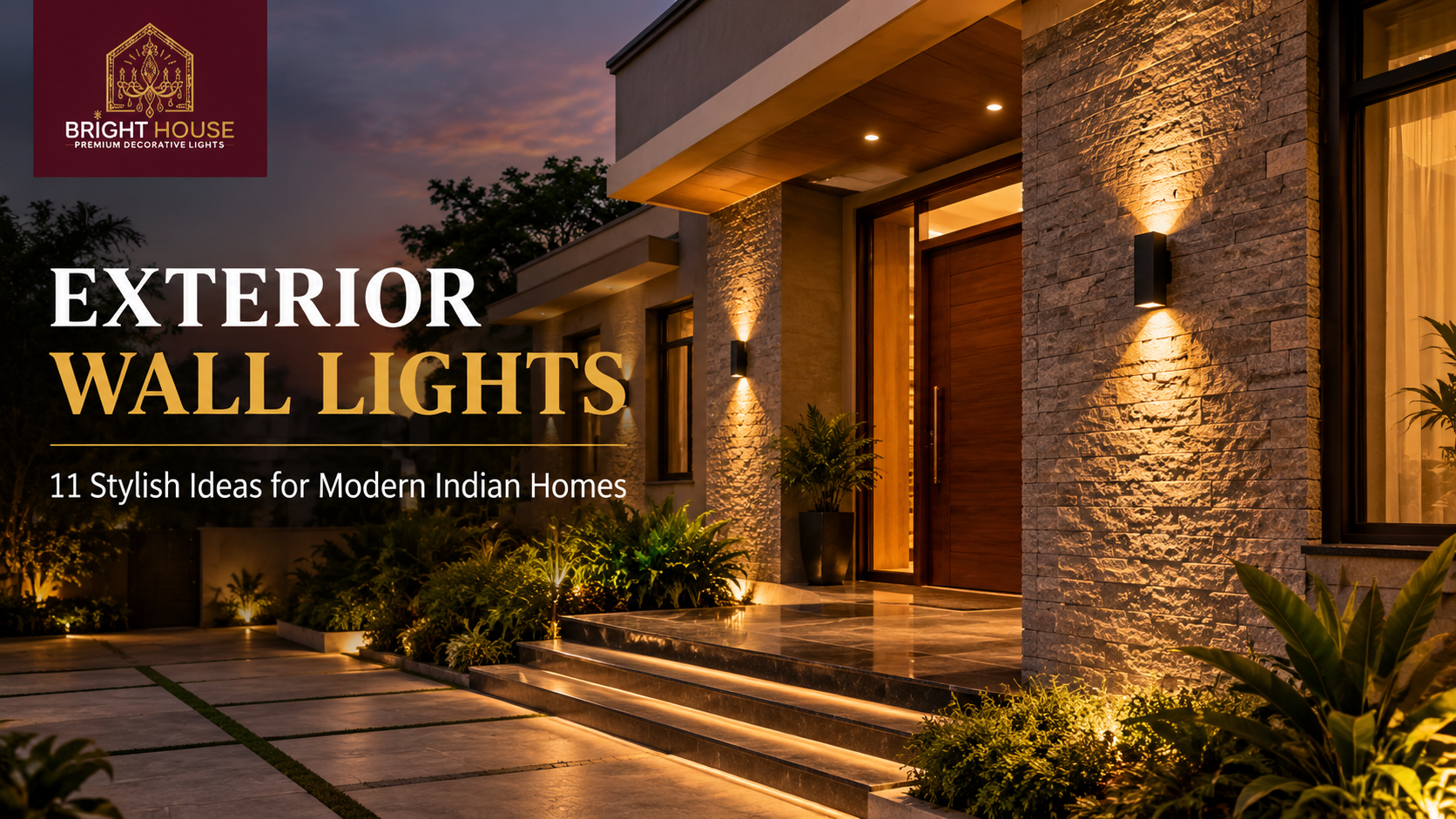
1. Which Outdoor Wall Lights Make a Home Look Modern?
Outdoor wall lights are among the most versatile choices for residential exteriors. They can illuminate entrances, balconies, verandas, compound walls and exterior corridors while adding a decorative touch.
Modern outdoor wall lights are available in geometric, cylindrical, rectangular and minimalist designs. Black, white, bronze and metallic finishes can complement different architectural styles.
Best for: Main entrances, balconies, exterior walls and covered porches.
Selection tip: Choose a fixture designed for the actual weather exposure of the installation location. For open walls exposed to rain, look for an appropriate outdoor-rated product, commonly IP65 or higher depending on the conditions.
Explore the Bright House guide to exterior wall lights design ideas for more inspiration.
2. Are LED Floodlights a Good Choice for Outdoor Security?
LED floodlights provide broad illumination across large outdoor areas. They are useful when visibility is more important than decorative appearance.
You can install them near driveways, parking spaces, building entrances, garages and larger yards. Compared with traditional lighting technologies, LED floodlights can offer good energy efficiency and long service life when properly selected.
Choose the wattage according to the size of the area, mounting height, beam angle and required brightness. A higher-wattage light is not automatically better because excessive brightness can create glare.
Best for: Driveways, parking areas, garages and large exterior spaces.
Selection tip: Consider motion sensor compatibility if the light is primarily intended for security. Position the fixture so it illuminates the target area without shining directly into neighbouring homes.
3. Why Choose Up and Down Outdoor Wall Lights?
Up and down lights direct illumination towards both the upper and lower sections of an exterior wall. This creates a distinctive lighting effect that can highlight architectural lines and textures.
These fixtures are particularly effective on contemporary homes with stone cladding, textured paint, decorative columns or simple geometric facades.
Choose warm white lighting for a welcoming appearance or neutral white when the exterior design calls for a cleaner, more contemporary effect.
Best for: Front elevations, entrance columns and architectural feature walls.
Selection tip: Install matching fixtures at balanced intervals. Avoid placing too many lights close together, as this can make the facade look visually crowded.
4. How Can Outdoor Gate Lights Improve Your Entrance?
Gate lights make the entrance easier to identify and help illuminate the area where people and vehicles enter the property.
You can install wall-mounted fixtures beside the gate, lights on gate pillars or decorative fixtures along the boundary wall. Matching designs on both sides of an entrance can create a symmetrical and organised appearance.
Best for: Main gates, compound walls, entrance pillars and driveway entrances.
Selection tip: Choose durable materials and weather-resistant construction. Ensure that the light does not dazzle drivers, pedestrians or neighbours.
For a coordinated appearance, match the gate lights with the exterior wall lights and other fixtures used on the front elevation.
5. Which Garden Lights Are Best for Pathways and Plants?
Garden lights help define walking routes and highlight landscaping features after dark. Instead of illuminating every part of the garden equally, use different fixtures to create depth and visual interest.
Path lights can guide people along walkways, while spotlights can highlight trees, shrubs and decorative plants. Low-level lights are useful near seating areas where bright illumination may feel uncomfortable.
Best for: Lawns, garden paths, flower beds and outdoor seating areas.
Selection tip: Select outdoor-rated fixtures and direct their beams towards the ground or intended feature. Avoid unnecessary upward light and excessive brightness.
Read the Bright House article on garden lighting ideas for more ways to plan your landscape lighting.
6. Are Solar Outdoor Lights Worth Buying?
Solar outdoor lights use energy collected from sunlight to charge a battery. Depending on their design, they can operate without a direct connection to your home's electrical supply.
They are useful where installing electrical wiring would be difficult or expensive. However, their performance depends on sunlight exposure, battery capacity, panel quality, weather conditions and the length of time they need to operate.
Best for: Garden borders, pathways, selected boundary areas and decorative outdoor spaces.
Selection tip: Check the expected operating time after charging, battery replacement options and weather resistance. Choose a location that receives sufficient sunlight during the day.
Solar lighting is not always a substitute for wired lighting. If you need consistent, high-output illumination for a main entrance or large driveway, compare both options carefully.
7. How Do Landscape Spotlights Highlight Exterior Features?
Landscape spotlights concentrate light on a particular object or surface. They can draw attention to trees, sculptures, textured walls, architectural columns and other features around your property.
A narrow beam creates a focused effect, while a wider beam illuminates a larger surface. The correct beam angle depends on the size and distance of the feature.
Best for: Trees, garden features, textured walls and decorative landscaping.
Selection tip: Position spotlights carefully to minimise glare and unwanted light spill. Use a consistent colour temperature across nearby fixtures for a coordinated result.
8. Which Outdoor Ceiling Lights Work Best for Porches?
Outdoor ceiling lights provide general illumination for covered entrances, verandas, balconies and sit-out areas. They can make these spaces more practical for evening conversations, relaxing or welcoming visitors.
Available styles include compact surface-mounted lights, flush-mount fixtures and decorative ceiling lamps designed for outdoor use.
Best for: Covered balconies, verandas, porches and sheltered seating areas.
Selection tip: Check the fixture's suitability for humidity and wind-driven rain. A covered ceiling does not automatically mean the light is protected from moisture.
Choose a design that complements nearby wall lights rather than introducing too many different finishes and styles.
9. Why Install Waterproof Step Lights?
Step lights improve visibility around staircases, changes in floor level and outdoor steps. They are usually installed at a low level so that light falls across the walking surface.
Recessed step lights offer a clean appearance, while surface-mounted options may be easier to install in suitable locations.
Best for: Exterior staircases, entrance steps, garden steps and level changes.
Selection tip: Choose fixtures designed for the exposure and installation method. Ensure that the beam illuminates each step adequately without creating glare.
Because these lights serve a safety function, plan their placement before installation instead of relying on decorative appearance alone.
10. Are Bollard Lights Suitable for Driveways and Gardens?
Bollard lights are upright fixtures that distribute light around pathways, garden edges and driveway borders. Their height and design make them useful for marking routes without necessarily illuminating the entire area.
They are available in contemporary cylindrical styles, square designs and decorative finishes.
Best for: Driveways, walkways, landscape borders and outdoor seating zones.
Selection tip: Choose a height and beam pattern that directs light onto the ground. Space the fixtures according to their light distribution, the width of the pathway and the brightness required.
Bollard lights can work particularly well when paired with subtle garden spotlights and wall-mounted entrance fixtures.
11. Can Outdoor Pendant Lights Make a Porch Look Elegant?
Outdoor pendant lights add a decorative focal point to covered entrances, verandas and outdoor dining spaces.
Lantern-inspired pendants can complement traditional architecture, while simple metal or glass designs work well with contemporary homes.
Best for: Covered entrances, sheltered patios and outdoor dining areas.
Selection tip: Check the manufacturer's outdoor suitability, mounting requirements and clearance recommendations. Avoid using indoor-only pendants in areas exposed to moisture.
Choose the pendant size according to the space. A fixture that is too large may overwhelm a small porch, while one that is too small may disappear visually in a spacious entrance.
12. What Are Wall Washer Lights Used For?
Wall washer lights distribute illumination across a broad vertical surface. They can reveal the texture of stone, brick, decorative plaster and other facade materials.
Depending on the fixture design, wall washers can be installed on the ground, near the wall or at suitable mounting points along the facade.
Best for: Large exterior walls, building elevations and architectural features.
Selection tip: Consider the distance between the fixture and the wall, the beam distribution and the surface finish. Test the lighting effect where possible because rough and smooth materials reflect light differently.
Wall washers are particularly useful when you want the architecture itself to become the main visual feature.
13. How Do Motion Sensor Outdoor Lights Work?
Motion sensor lights switch on when their sensors detect movement within a configured area. Some models combine motion detection with dusk-to-dawn sensors, allowing them to activate only when it is dark.
They can improve convenience around secondary entrances, garages and less frequently used exterior spaces.
Best for: Side entrances, rear doors, garages and utility areas.
Selection tip: Check the detection range, adjustment settings and sensor coverage. Position the fixture to avoid unnecessary activation from passing traffic, moving plants or other unwanted triggers.
Motion sensor lights are most effective when their detection area matches the space you want to monitor.
14. Are Decorative String Lights Good for Outdoor Spaces?
Decorative string lights create a relaxed atmosphere in suitable outdoor seating areas. They can be used along pergolas, covered patios and garden entertainment spaces.
Warm light generally creates a comfortable ambience for social gatherings. However, decorative lighting should supplement, rather than replace, the illumination needed for steps and walking routes.
Best for: Covered patios, pergolas, garden seating and outdoor celebrations.
Selection tip: Check the product's outdoor rating, cable suitability and installation instructions. Use secure mounting points and keep electrical connections protected from water.
Avoid overloading a circuit or connecting products in ways the manufacturer does not permit.
15. When Should You Choose Recessed Exterior Lights?
Recessed exterior lights fit into ceilings, soffits, steps or other suitable surfaces, creating a neat appearance with minimal visible hardware.
They are useful when you want illumination without adding prominent fixtures to the architecture.
Best for: Covered entrance ceilings, soffits, suitable outdoor steps and sheltered passageways.
Selection tip: Confirm that the fixture is suitable for the installation location and that the ceiling or surface can accommodate it. Consider heat management, drainage and access for maintenance.
Recessed lighting works best when it is planned during construction or renovation, although some suitable surface conditions may allow later installation.
How Do You Choose the Best Outdoor Lights for Your Home?
The best approach is to select each fixture according to its purpose, location and environmental exposure. Use this checklist before purchasing.
| Factor | What to check | Why it matters |
|---|---|---|
| Weather protection | Appropriate IP rating | Helps protect against dust and water |
| Brightness | Lumens and beam spread | Determines how effectively an area is illuminated |
| Colour temperature | Warm, neutral or cool white | Influences the appearance and atmosphere |
| Material | Suitable metal, coating or housing | Affects durability and maintenance |
| Energy efficiency | LED performance and wattage | Helps manage electricity consumption |
| Installation | Mounting type and wiring needs | Ensures the fixture suits the location |
| Warranty | Manufacturer's written terms | Clarifies support and replacement conditions |
| Maintenance | Cleaning and component access | Helps keep the lighting working properly |
What IP Rating Should Outdoor Lights Have?
An IP rating describes protection against the entry of solid objects and water under specified test conditions. The appropriate rating depends on how exposed the fixture is.
| Location | General selection guidance |
|---|---|
| Deeply sheltered porch | Consider IP44 or IP54 where suitable |
| Covered but humid balcony | Check the actual exposure and product rating |
| Open exterior wall | IP65 is a common starting point |
| Exposed garden or pathway | Consider IP65-rated fixtures designed for the location |
| Areas at risk of temporary immersion | Assess whether an appropriate IP67 product is required |
These are general guidelines, not universal guarantees. An IP rating does not establish resistance to corrosion, impact or every possible installation condition. Always follow the manufacturer's instructions and applicable electrical safety requirements.
Which Colour Temperature Is Best for Outdoor Lighting?
Colour temperature is measured in kelvin (K). It affects whether a light appears warm, neutral or cool.
-
2700K to 3000K: Warm white, suitable for welcoming entrances, gardens and relaxing outdoor seating.
-
Around 4000K: Neutral white, useful for practical areas where a balanced appearance is preferred.
-
5000K and above: Cooler white, which may suit selected functional applications but can look harsh when used excessively around a home.
For a coordinated exterior, use similar colour temperatures in areas that are visible together. Avoid mixing several noticeably different white tones across a small facade unless the contrast is intentional.
For further guidance, consult the outdoor lighting buying guide from Lowe's.
How Can You Plan Outdoor Lighting on a Budget?
A good outdoor lighting plan does not require installing a fixture at every available point. Start with the areas that need visibility, then add decorative lighting where it creates the greatest impact.
Follow these practical steps:
-
Prioritise essential areas. Begin with entrances, steps, pathways and parking spaces.
-
Choose the main visual feature. Highlight the facade, a tree or the entrance rather than lighting every surface.
-
Use efficient LED fixtures. Compare brightness, power consumption and expected service life.
-
Avoid unnecessary duplication. One well-positioned light may perform better than several poorly placed fixtures.
-
Consider controls. Timers, dusk sensors and motion sensors can reduce unnecessary operating time.
-
Compare total cost. Include installation, wiring, maintenance and replacement, not only the initial product price.
Actual costs vary by fixture quality, size, installation complexity, brand and location. Obtain a product quotation and an installation estimate before finalising your budget.
What Outdoor Lighting Mistakes Should You Avoid?
Even attractive fixtures can produce disappointing results if they are installed incorrectly.
Avoid these common mistakes:
-
Buying indoor fixtures for exposed outdoor locations.
-
Choosing a product without checking its IP rating.
-
Using excessive brightness near doors, windows or neighbouring properties.
-
Mixing incompatible colour temperatures across the same facade.
-
Installing pathway lights where they create glare instead of illuminating the ground.
-
Ignoring corrosion resistance in coastal or highly humid environments.
-
Leaving cables and electrical connections exposed to water.
-
Failing to plan access for cleaning and future maintenance.
Outdoor electrical installation should be completed by a qualified professional. Use suitable protection, weather-rated connections and installation methods appropriate to the site.
- Fybros Lysa 10W outdoor wall light Moglix product listing
- Waterproof 6W up-and-down wall light Pepperfry product listing
| Option | cost | timing |
|---|---|---|
| Outdoor wall lights | ₹289–₹1,500 per light | 30–60 minutes per light |
| LED floodlights | ₹499–₹1,500 per light | 30–90 minutes per light |
Serving Bangalore and nearby: JP Nagar, Bengaluru, MG Road, Bengaluru, Banashankari, Bengaluru, Electronic City, Bengaluru, BTM Layout, Bengaluru.
Frequently asked questions
1. Which outdoor lights are best for a modern house?
Modern outdoor wall lights, up and down lights, recessed fixtures and LED landscape spotlights are popular choices. Select designs that complement the building and provide the required illumination.
2. Which outdoor lights are best for Indian weather?
Choose fixtures designed for the local conditions, with appropriate water and dust protection, durable construction and corrosion-resistant materials where necessary. Exposed fixtures commonly require IP65 protection or higher, depending on the application.
3. Are LED outdoor lights better than traditional lights?
LED outdoor lights can provide good energy efficiency, long service life and a wide range of designs. Compare actual lumen output, power consumption, warranty and product quality before buying.
4. Are solar outdoor lights suitable for every home?
No. Solar lights are useful where sunlight and installation conditions are suitable. Their performance depends on charging conditions, battery capacity and the light output required.
Sources
- moglix.com
- pepperfry.com
Written by Bright House, Marketing · Reviewed by Team, Team
Bright House · shop-8, Ground floor, no.34, Chickpet, Bengaluru, Karnataka, 560033 · 9964961888