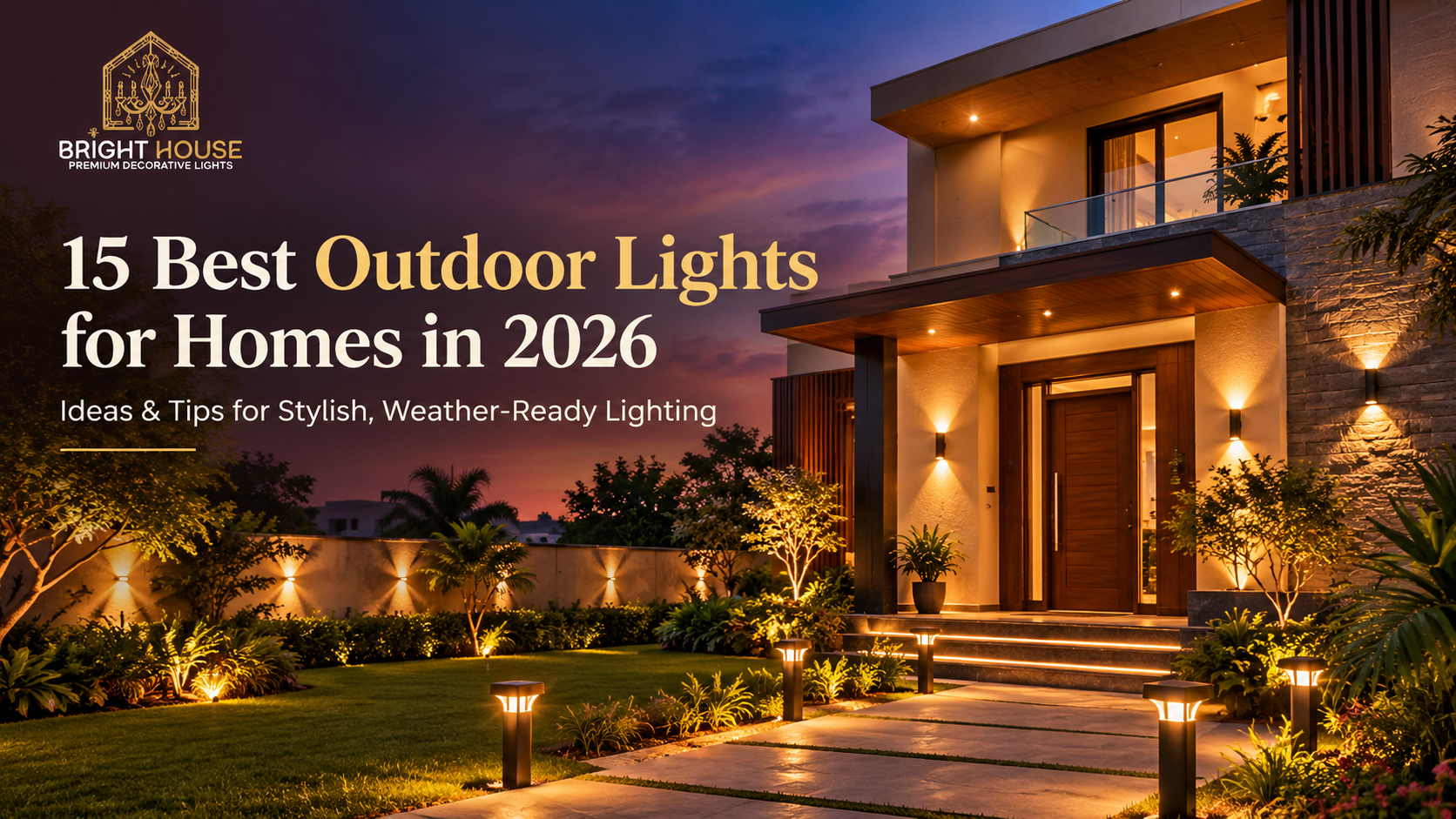
The exterior of your home creates the first impression before anyone steps inside. From the main entrance to the balcony, compound wall and front elevation, the right lighting can make an ordinary facade look elegant, welcoming and visually appealing after sunset.
Exterior wall lights are an effective way to combine decorative appeal with practical illumination. They highlight architectural details, improve visibility near entrances and pathways, and help create a consistent appearance across different outdoor areas.
Modern homes have many lighting options, including LED wall lamps, minimalist fixtures, lantern-style designs and up and down lights. However, choosing the right fixture involves more than selecting an attractive shape. You also need to consider weather protection, brightness, colour temperature, material and installation position.
This guide explores 11 exterior wall lights design ideas for Indian homes and explains how to choose the right fixtures.
What Are Exterior Wall Lights and Why Do Homes Need Them?
Exterior wall lights are lighting fixtures installed on outdoor walls to illuminate entrances, balconies, exterior corridors, compound walls and architectural features. They can provide functional lighting, decorative accents or a combination of both.
Unlike indoor wall lamps, exterior fixtures should be selected for their intended outdoor environment, including exposure to rain, dust, humidity and sunlight.
The main benefits of exterior wall lighting include:
-
Improved visibility: Illuminate doorways, steps and outdoor passageways.
-
Enhanced appearance: Highlight textures, stone cladding, paint finishes and architectural lines.
-
A welcoming entrance: Create a comfortable atmosphere for residents and visitors.
-
Better lighting control: Use separate switches, timers or motion sensors where suitable.
-
Design consistency: Coordinate the lighting with doors, windows, railings and exterior finishes.
The best results come from selecting lights according to the purpose of each area instead of installing identical fixtures everywhere.
What Are the 11 Best Exterior Wall Lights Design Ideas?
The best exterior wall lights depend on your home's architecture, the available wall space and the amount of illumination required. These ideas cover contemporary homes, traditional houses, villas and apartments.
1. Modern Minimalist Wall Lights
Simple rectangular or cylindrical fixtures suit contemporary homes with clean lines. Black, white and neutral finishes work particularly well with concrete, white paint and modern exterior materials.
These lights are ideal for modern house facades, entrance walls and side passages. Choose a design that complements the shape of your windows, doors and other exterior features.
2. Up and Down Wall Lights
Up and down wall lights direct illumination upwards and downwards, creating a distinctive pattern on the wall. They are especially attractive on plain surfaces and textured exterior finishes.
These fixtures are suitable for front elevations, pillars and feature walls. For a balanced effect, position them at consistent heights and avoid placing too many close together.
3. Decorative Outdoor Lanterns
Lantern-style fixtures add character to traditional houses, villas and homes with classic architectural details. Glass and metal combinations offer a timeless appearance.
They work particularly well beside main entrances, verandas and covered porches. Check that the materials and electrical components are designed for the intended outdoor exposure.
4. Cylindrical Exterior Wall Lights
Cylindrical wall lamps provide a neat, understated appearance. Depending on their design, they can create downward illumination, diffused light or decorative beams.
They are suitable for narrow pillars, compact entrances and contemporary exterior walls. Their simple shape makes them easy to coordinate with other modern lighting fixtures.
5. Entrance Wall Sconces
A pair of matching lights beside the main door creates visual balance and helps illuminate the entrance. Choose fixtures proportionate to the door and surrounding wall.
Entrance sconces can make the doorway more welcoming while improving visibility for people arriving after dark. Consider warm white light for a comfortable residential atmosphere.
6. Textured-Wall Lighting
Light directed across stone, brick or textured plaster brings out surface details and adds depth to the facade. A suitable beam angle is important for achieving an attractive effect.
This approach works well with stone cladding, architectural feature walls and premium home elevations. Before installation, consider the texture and colour of the wall because these affect how the light appears.
7. Balcony Wall Lights
Compact wall-mounted fixtures provide comfortable illumination without taking up floor space. Shielded designs can help prevent glare when people are seated nearby.
For apartment balconies and terraces, select a fixture that suits the available space and does not create excessive brightness. Always check building rules before drilling into external walls or modifying electrical installations.
8. Compound Wall Lights
Compound wall lights can illuminate boundary walls, gate pillars and entrance approaches. They can also create a coordinated appearance between the main house and its surrounding walls.
Choose durable fixtures with appropriate weather protection. The spacing should depend on the wall height, fixture output and beam spread rather than appearance alone.
9. Step and Pathway Wall Lights
Low-mounted fixtures can make changes in level easier to see. Their placement should illuminate the walking surface without shining directly into people's eyes.
These lights are useful for exterior stairs, raised entrances and garden walkways. Ensure that the selected fixture is designed for its mounting position and that the installation does not create trip hazards.
10. Premium Metallic Wall Lights
Brass-look, bronze, dark metal and other coordinated finishes can complement upscale exterior designs. They work particularly well with neutral paint, stone cladding and contemporary architectural details.
Check the actual material and protective finish rather than judging by colour alone. Outdoor exposure can affect durability, especially in humid or coastal environments.
11. Sensor-Enabled Exterior Lights
Motion-activated fixtures illuminate selected areas when movement is detected. They can be useful around side entrances, garages and less frequently used access points.
Choose a sensor with a suitable detection range and adjustable settings where available. Sensor lighting can improve visibility and reduce unnecessary operating time, although it should be considered one part of a broader home security plan.
How Do You Choose Exterior Wall Lights for Different Areas?
Different parts of a home require different lighting solutions. A decorative fixture that looks beautiful beside the main entrance may not provide enough visibility for steps or a driveway.
| Outdoor area | Recommended style | Main consideration |
|---|---|---|
| Main entrance | Matching wall sconces | Comfortable, balanced illumination |
| Front elevation | Up and down lights | Beam pattern and wall texture |
| Balcony | Compact LED wall lights | Low glare and comfortable brightness |
| Compound wall | Weather-resistant wall fixtures | Exposure to rain and dust |
| Exterior staircase | Shielded step lights | Visibility of each step |
| Garage entrance | Functional or sensor lights | Clear visibility and coverage |
| Garden-facing wall | Decorative or directional lights | Highlighting plants and surfaces |
For a coordinated appearance, select one main finish across connected outdoor areas. You can vary fixture shapes while keeping the overall design consistent.
If you are planning lighting for indoor spaces as well, explore the Bright House lighting collection for ideas on coordinating different fixture styles.
Which IP Rating Should You Choose for Exterior Wall Lights?
The IP rating indicates how well a fixture is protected against the entry of dust and water under specified test conditions. It is one of the most important specifications when choosing outdoor wall lights for an Indian home.
The correct rating depends on how exposed the fixture is to rain, water spray and dust.
| IP rating | General protection | Potential application |
|---|---|---|
| IP44 | Protection against solid objects over 1 mm and splashing water | Sheltered locations, where suitable |
| IP54 | Limited dust ingress and splashing-water protection | Protected outdoor areas |
| IP65 | Dust-tight and protected against water jets | Many exposed exterior walls |
| IP66 | Dust-tight and protected against powerful water jets | More demanding exposed locations |
| IP67 | Dust-tight and protected against temporary immersion under specified test conditions | Locations where temporary immersion is a relevant risk |
For an exposed facade, IP65 is a useful starting point, subject to the manufacturer's instructions and site conditions. IP67 is not automatically the best choice for every outdoor wall because its water test differs from the IP65 and IP66 jet tests.
Also consider the fixture's housing material, seals, cable entry and installation quality. Homes near the coast may require corrosion-resistant materials and finishes in addition to an appropriate IP rating.
Never assume an indoor wall lamp is suitable for outdoor use simply because it is installed under a roof.
Should You Choose Warm White or Cool White Exterior Lighting?
Colour temperature affects how your exterior looks at night. Warm white creates a softer, more inviting appearance, while neutral or cool white can suit modern designs where crisp visibility is preferred.
| Light colour | Typical appearance | Suitable applications |
|---|---|---|
| 2700K to 3000K | Warm, golden white | Entrances, balconies and decorative facades |
| 3500K to 4000K | Neutral white | Contemporary exterior areas and general visibility |
| 5000K and above | Cool, crisp white | Selected functional applications where appropriate |
For most decorative residential facades, warm white is a strong option. It works well with brick, wood-look finishes, beige paint and natural stone.
However, colour temperature should not be your only consideration. Check brightness, beam direction and glare as well. A very bright fixture can make an entrance uncomfortable even when its colour is attractive.
Use a consistent colour temperature across connected sections of the same facade to prevent the exterior from looking visually disjointed.
How Many Exterior Wall Lights Does a House Need?
There is no fixed number of exterior wall lights for every house. The right quantity depends on the size of the facade, entrance dimensions, wall length, fixture output and intended lighting effect.
Use the following planning approach:
-
Main entrance: Assess whether one well-positioned light or a balanced pair provides the necessary illumination.
-
Long compound walls: Divide the wall into sections and check beam spread and overlap before fixing the spacing.
-
Balconies: Focus on seating areas and access points instead of illuminating every section equally.
-
Exterior steps: Ensure the walking surface and changes in level remain visible.
-
Feature walls: Use a few carefully placed fixtures to emphasise selected architectural details.
Before installation, review the layout at night if possible. Check for dark patches, excessive brightness and unwanted light entering neighbouring windows.
Avoid choosing the quantity solely by counting wall sections. Two different fixtures can produce very different light patterns even when they have the same wattage.
What Is the Best Height for Installing Exterior Wall Lights?
The appropriate mounting height depends on the fixture design, the wall's dimensions and the purpose of the lighting. For many conventional wall sconces, a centre height of approximately 1.65 to 1.80 metres above the finished ground level can be a useful starting point.
This is not a universal rule. Low-level step lights, tall facade fittings and decorative lights on gate pillars require different positions.
Before installation, consider these points:
-
Check the manufacturer's recommended mounting height.
-
Position the light so that its source does not shine directly into people's eyes.
-
Make sure the fixture illuminates the intended surface or walking area.
-
Keep matching lights at consistent heights when symmetry is part of the design.
-
Confirm that the fixture can be accessed safely for cleaning and maintenance.
Plan wiring points before exterior painting or cladding begins. This reduces visible cables and avoids unnecessary drilling after the finishing work is complete.
Are LED Exterior Wall Lights Energy-Efficient?
LED exterior wall lights are a popular option because they can provide useful illumination with relatively low electrical consumption. Actual efficiency depends on the product's lumen output, power consumption, driver quality and operating conditions.
Compare light output in lumens with wattage rather than assuming that a higher-wattage product is always better.
For example, a 10-watt LED fixture operating for five hours each night uses approximately 1.5 kWh over 30 days:
10 watts × 5 hours × 30 days ÷ 1,000 = 1.5 kWh.
This calculation estimates energy consumption, not the electricity bill. Your actual cost depends on your tariff and the number of fixtures installed.
You can manage consumption further by:
-
Selecting efficient LED products with suitable output.
-
Using timers or motion sensors where appropriate.
-
Switching off decorative lights when they are not needed.
-
Choosing fixtures that direct light towards the intended area.
-
Cleaning fixtures periodically to maintain useful light output.
Responsible outdoor lighting also means avoiding unnecessary brightness and directing light only where it is useful. The U.S. Department of Energy's guide to responsible outdoor lighting explains why targeted illumination, appropriate brightness and lighting controls matter.
What Should You Check Before Buying Exterior Wall Lights?
A simple checklist can help you compare exterior wall lights effectively and avoid selecting a product based on appearance alone.
-
Outdoor suitability: Confirm that the product is intended for the actual installation environment.
-
IP rating: Match the water and dust protection to the exposure.
-
Material and finish: Check resistance to corrosion, humidity and sunlight.
-
Brightness: Review the lumen output and intended coverage.
-
Colour temperature: Choose a tone that complements the facade.
-
Beam direction: Consider up and down beams, downward illumination or diffused light.
-
Electrical compatibility: Confirm the voltage, driver requirements and installation instructions.
-
Maintenance: Check whether the LED source or driver can be serviced or replaced.
-
Warranty: Read the warranty conditions, including exclusions for incorrect installation or unsuitable exposure.
-
Overall design: Match the fixture to the architecture and other exterior finishes.
For mains-powered exterior installations, use a qualified electrician and appropriate electrical protection. Keep wiring, junctions and cable entries suitable for outdoor exposure.
Frequently Asked Questions About Exterior Wall Lights
1. Which exterior wall lights are best for modern homes?
Minimalist rectangular lights, cylindrical fixtures and up and down LED wall lights are popular choices for modern homes. Select the shape, finish and beam pattern to suit the facade.
2. Are exterior wall lights waterproof?
Some are designed to withstand specific levels of water exposure, but protection varies by product. Check the IP rating and manufacturer's installation instructions before buying.
3. Is IP65 suitable for exterior wall lights in India?
IP65 is a useful starting point for many exposed exterior walls because it provides dust-tight protection and protection against water jets. Consider local weather, coastal corrosion and the manufacturer's specifications before making a final selection.
4. What colour is best for outdoor wall lights?
Warm white between 2700K and 3000K is often suitable for decorative residential lighting. Neutral white may be preferable for some functional areas or modern designs.
5. Can exterior wall lights improve home security?
They can improve visibility near entrances, access points and outdoor pathways. Motion sensors can be useful in selected locations, but lighting alone does not guarantee security.