Search for fancy lights in India and you get two completely different things: two hundred rupee fairy light strings, and forty thousand rupee chandeliers. Both are sold under the same phrase, which is why so many people end up buying the wrong one.
This guide covers fancy lights for home decoration that stay up all year. Seven fixture families, how to size each one for an Indian ceiling, and the checks that separate a light worth keeping from one you replace by next Diwali.
The Short Version
- Permanent wired fixtures hold their value. String lights are seasonal decoration.
- Seven fixture families cover almost every room in an Indian home.
- Size the fixture to your room, never to how it looked in the showroom.
- Check the BIS registration mark and the colour temperature before you pay.
- One fixture per room is a lit room. Three layers is a designed room.
What Counts As A Fancy Light For A Home?
A fancy light is any fixture chosen for how it looks as much as for what it lights. In practice the fancy lights for home interiors split into two groups: permanent wired pieces that become part of the room, and seasonal string decoration that comes down after the festival.
The distinction matters because the two are bought differently. A string of fairy lights is an impulse purchase measured in metres. A wired fixture is a five to fifteen year decision measured in ceiling height, load, and light quality.
Permanent decorative lighting includes:
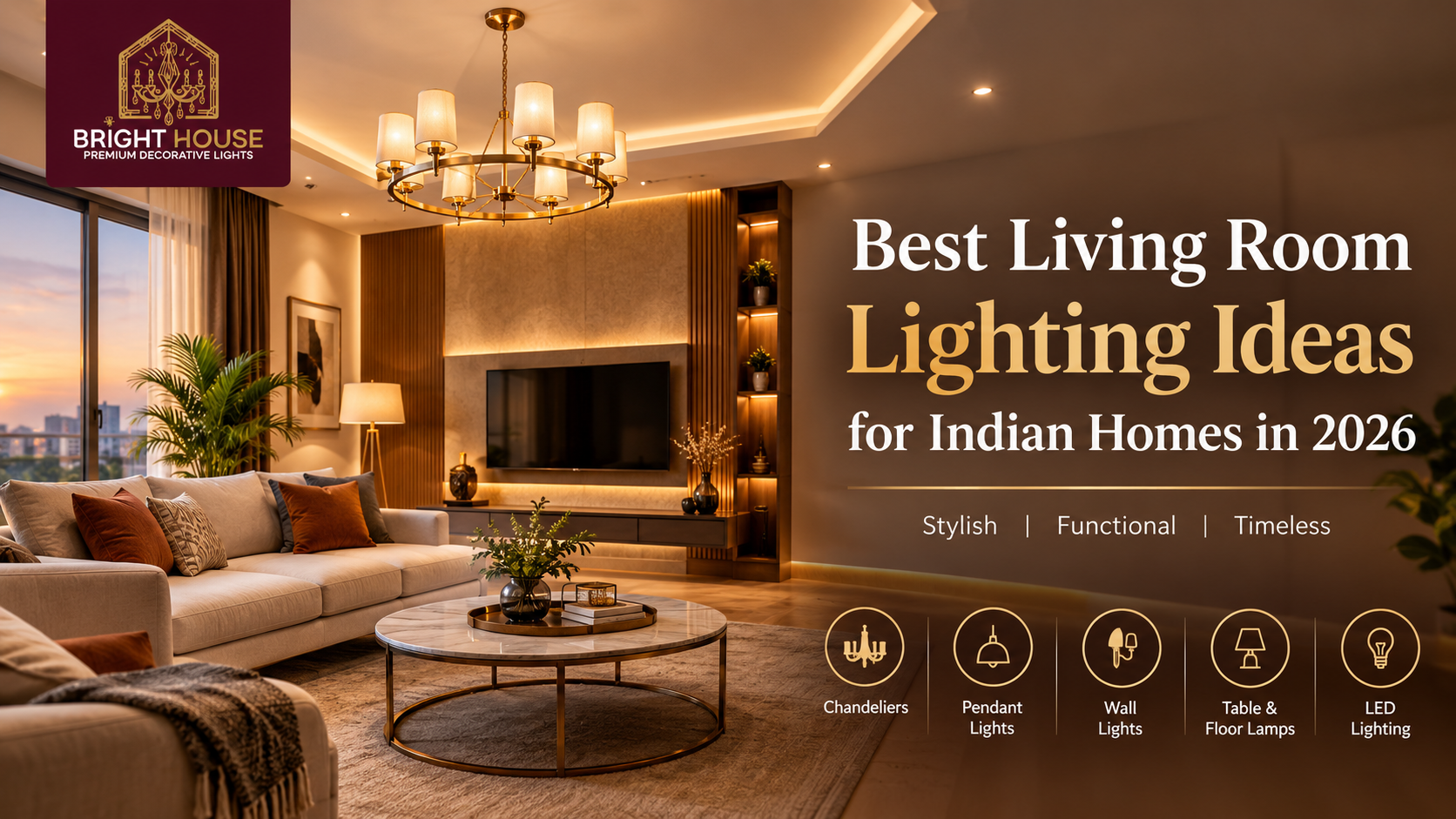
- Chandeliers, pendants, and flush ceiling fixtures
- Wall sconces and picture lights
- Table lamps and floor lamps
- Concealed cove and profile lighting
Festive lighting includes string lights, rope lights, curtain lights, and diya sets. These are worth buying, but they decorate a room rather than light it. Treat them as a seasonal layer on top of fixtures that already work.
The reason this guide concentrates on the permanent group is simple economics. A fixture that costs twenty thousand rupees and lasts twelve years costs less per year than a thousand rupee string set replaced every festival season.
Permanent fixtures also change how a room feels at every hour, not just during a celebration. That is the difference between decoration and design.
Which Fancy Light Suits Which Room?
Seven fixture families cover almost every situation in an Indian home. Most fancy lights for home use fall into one of them, and each has a height or clearance rule that decides whether the piece looks deliberate or accidental.
|
Fixture |
Best room |
Height rule |
Watch out for |
|
Chandelier |
Living, dining, foyer |
Base clears 7 ft in any walkway |
Needs an anchor into the slab, not plaster |
|
Pendant or cluster |
Dining, counter, bedside |
30 to 36 in above the table top |
Too small reads as an afterthought |
|
Wall sconce |
Corridor, bedside, stairs |
5 to 5.5 ft from the floor |
Glare from open shades at eye level |
|
Table lamp |
Side table, study, bedside |
Shade bottom near seated eye level |
A shade too narrow for the base |
|
Floor lamp |
Reading corner, sofa end |
Shade 4 to 4.5 ft from the floor |
Light bases tip over easily |
|
Cove or profile |
Living and bedroom ceilings |
Cove at least 100 mm deep |
A shallow cove shows the strip |
|
Flush ceiling |
Low ceilings, passages |
Ceilings under 9 ft |
Flat light with no depth |
A common mistake is buying two fixtures from the same family for one room. A chandelier plus a matching pendant reads as a showroom display. A chandelier plus sconces plus a lamp reads as a home.
Ceiling height decides the shortlist before style does. Below nine feet, a flush fixture or a shallow pendant keeps the room feeling tall. Above eleven feet, a small fixture disappears and the room reads as unfinished.
Rooms with a false ceiling need one extra question answered early. Ask where the slab sits above the plaster, because that is what carries the weight of anything heavier than a few kilograms.
How Do You Size A Fixture Correctly?
Sizing is arithmetic, not taste. Add the room length and width in feet, then read that total as inches to get a sensible fixture diameter. A 12 by 14 foot living room suits a piece around 26 inches wide, which is larger than most people expect.
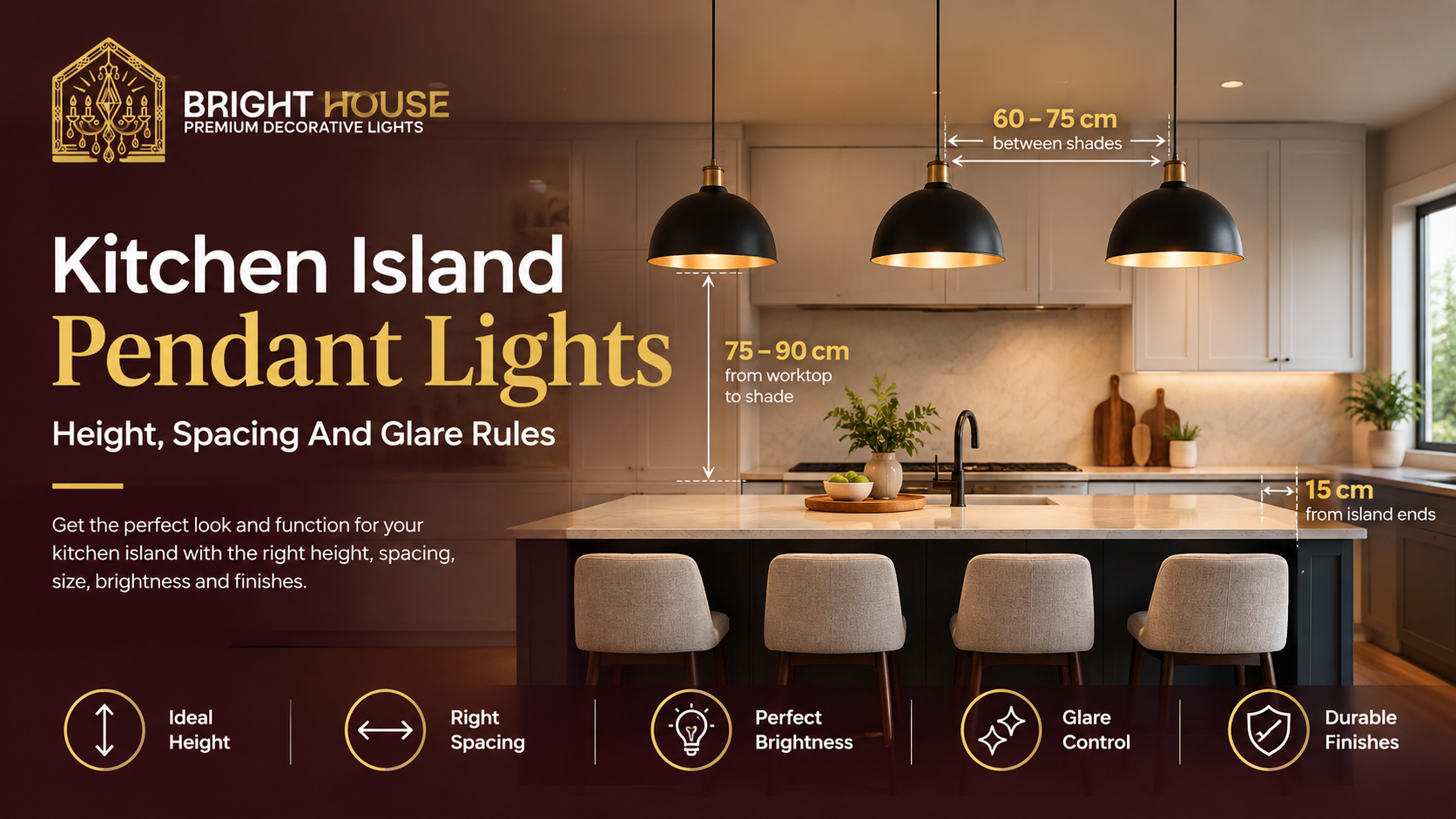
Height follows a separate rule. Allow roughly 2.5 to 3 inches of fixture height for every foot of ceiling, so a 10 foot ceiling carries a fixture 25 to 30 inches tall. Over a dining table, size the piece to half or two thirds of the table width.
Fancy lights for home interiors fail on scale far more often than on style. In an open plan flat, size the piece to the zone it hangs over rather than the whole floor area, or the number comes out much too large.
The same sizing logic applies across every material, and our guide to styling white chandeliers works through it room by room.
When a calculation lands between two available sizes, take the larger one. An undersized fixture looks like a mistake, while a slightly generous one simply looks confident.
What Should You Check Before You Buy?
Five checks catch almost every bad purchase. Run them before you pay, because none of them are visible in a product photograph and most sellers will not raise them for you.
LED lamps, fixed general purpose LED luminaires, LED control gear, and even dimmers for LED products all sit on the Bureau of Indian Standards compulsory registration list, so a legitimate fixture carries a registration mark. No mark is a reason to walk away.
- Colour temperature. 2700K to 3000K for living and sleeping areas. Anything above 4000K reads as an office.
- Colour rendering. A CRI of 80 or above, ideally 90 for dining, or food and skin tones look grey.
- Dimming. Confirm the fixture is dimmable and which dimmer type it needs. Retrofitting a dimmer later is expensive.
- Materials. Real glass, brass, stone, or ceramic ages. Thin plastic yellows within a few monsoons.
- Weight and spares. Ask the shipping weight, and ask whether replacement glass or crystals can be bought separately in three years.
That last point is the one buyers skip. A fixture with no spare parts is disposable, however good it looks on day one.
Ask for the ingress rating too if the piece goes anywhere near a balcony, a bathroom, or an open corridor. An indoor fitting in a damp spot corrodes at the fittings long before the glass gives up.
What Do Fancy Lights For Home Cost In India?
Prices cluster into three clear bands, and the jump between them is driven by material and finish rather than by size. Knowing the band you are shopping in saves far more time than browsing by style, because it cuts the shortlist immediately.
|
Fixture |
Entry |
Mid range |
Statement |
|
Chandelier |
₹12,000 to ₹25,000 |
₹25,000 to ₹65,000 |
₹65,000 and above |
|
Pendant light |
₹4,000 to ₹10,000 |
₹10,000 to ₹25,000 |
₹25,000 and above |
|
Wall sconce |
₹2,000 to ₹4,000 |
₹4,000 to ₹9,000 |
₹9,000 and above |
|
Table lamp |
₹2,500 to ₹4,000 |
₹4,000 to ₹9,000 |
₹9,000 and above |
|
Floor lamp |
₹5,000 to ₹9,000 |
₹9,000 to ₹20,000 |
₹20,000 and above |
Entry pieces usually mean plated metal and moulded acrylic. Mid range brings solid brass, real glass, and better finishing on the joints. Statement pieces add hand work, stone, or cut crystal, which is where the cost climbs steeply.
Budget for fancy lights for home projects the way an interior designer does, at roughly two to five percent of the room budget. Spend the largest share on the one fixture people look at, and keep the supporting layers modest.
Installation is the line item most people forget. Allow between fifteen hundred and eight thousand rupees per fixture depending on ceiling height and whether the wiring point already exists.
How Do You Layer Fancy Lights In One Room?
Layering is what separates a designed room from a lit one. Good fancy lights for home schemes use three layers at different heights, on separate switches, so one room can shift from bright to intimate without changing a bulb.
- Choose the focal fixture first. A chandelier or pendant sets the scale and style for everything else.
- Bring the glow down to eye level with designer wall lights placed around 5 to 5.5 feet from the floor.
- Add a low pool of light with table lamps or a floor lamp beside seating.
- Put each layer on its own switch, and dim the ceiling layer.
- Match colour temperature across all three, or the room reads as patchy.
Decorative lights for home use only work together when the metals agree too. Repeat one finish, brass or black or nickel, across the fixtures in a single sightline, and stop at two metals.
Frequently Asked Questions
Which Lights Are Best For A Living Room?
A chandelier or large pendant as the focal point, wall sconces at eye level, and one table or floor lamp beside the sofa. Put the ceiling layer on a dimmer.
Are Fancy Lights For Bedroom Use Different?
Yes. Bedrooms need lower glare, so choose closed or fabric shades rather than open crystal arms, and keep everything at 2700K with a dimmer beside the bed.
How Much Should You Spend?
Good fancy lights for home interiors in India start around twelve thousand rupees for a small chandelier and rise past a lakh for large statement pieces. Sconces and lamps typically run two to six thousand.
Do LED Fixtures Work With Every Dimmer?
No. Integrated LED fixtures need a compatible trailing edge or leading edge dimmer, and fitting the wrong one causes flicker and buzzing, so confirm the type before wiring.
Are Decorative Lights For Home Safe To Leave On?
Modern LED fixtures run cool and are safe for long periods. Festive string lights are the exception and should be switched off overnight and unplugged when nobody is home.
How Often Do Decorative Fixtures Need Cleaning?
Dust monthly with a dry microfibre cloth. In Indian cities, open crystal and glass arms need a proper clean every six months or the sparkle dulls noticeably.
Where Should You Start?
Start by measuring the room and deciding which layer is missing, because most homes already have a ceiling light and nothing else. Once you know the diameter and the drop you need, the choice narrows quickly.
Buy the focal fixture first and live with it for a few weeks. The sconces and lamps are much easier to choose once the main piece is up and you can see what the room still lacks.
Fancy lights for home projects are much easier to judge in person than on a screen, so visit a Bright House showroom and see the fixtures lit before you commit, or browse the full chandelier collection to compare sizes and finishes first.