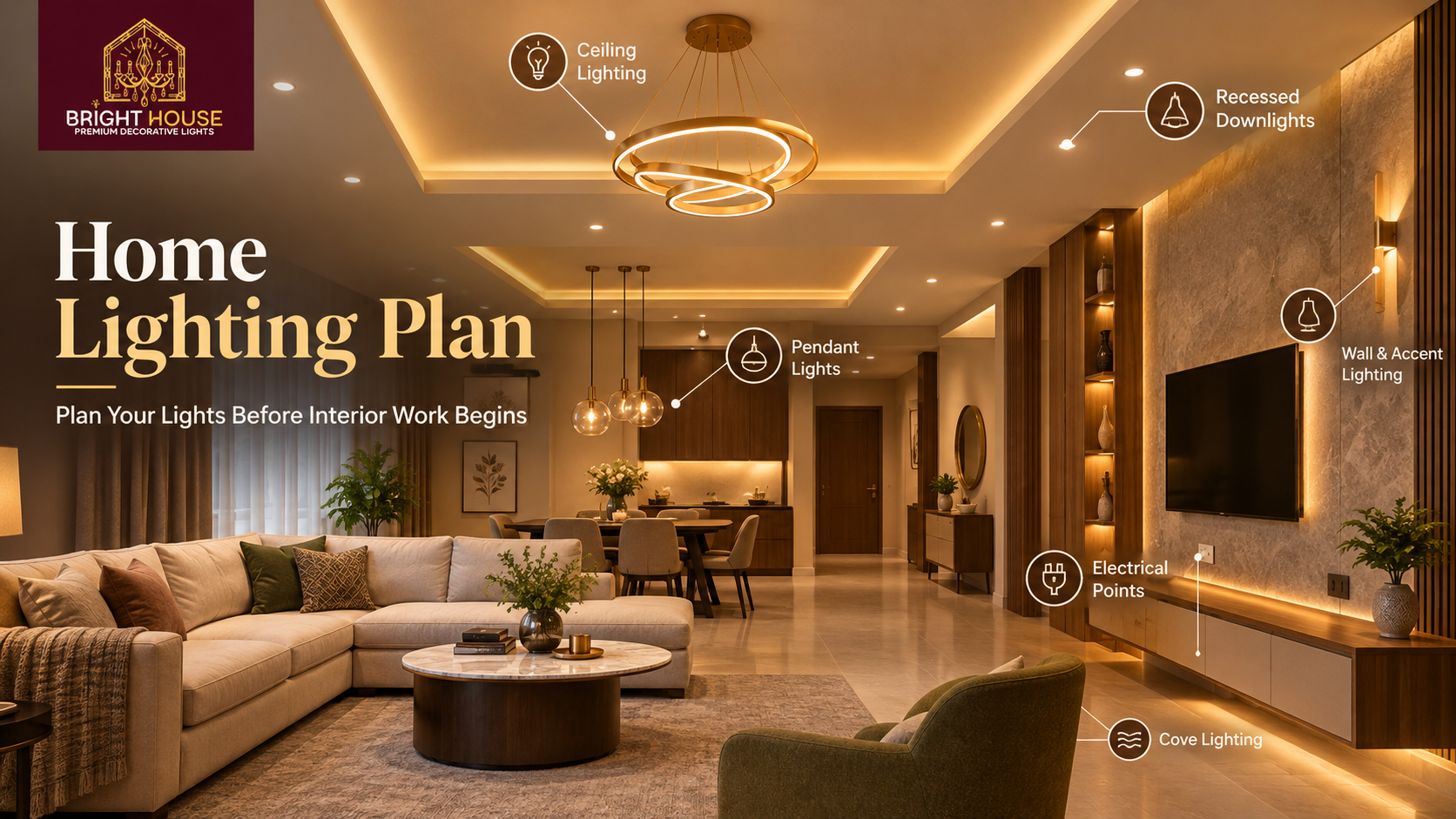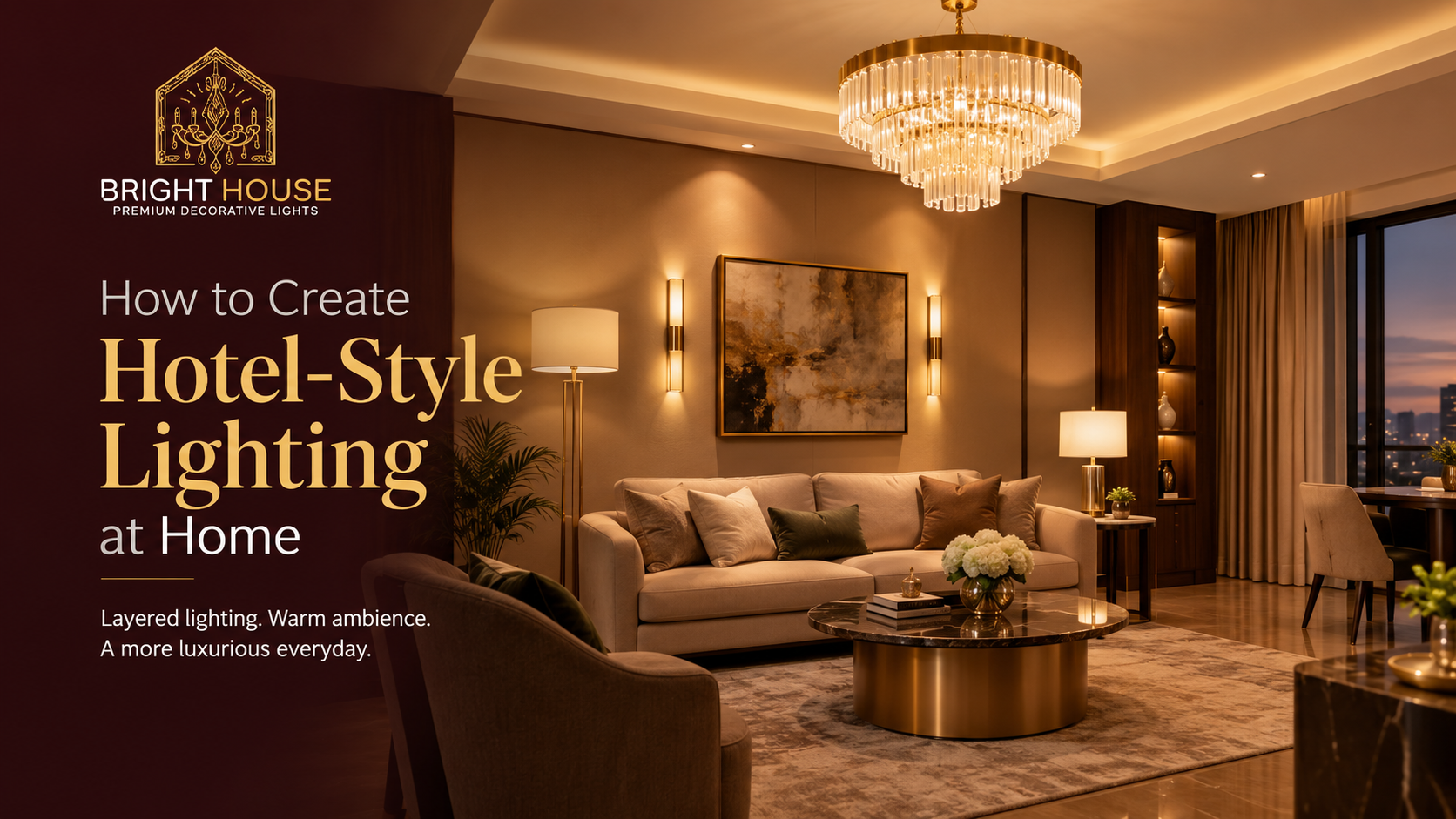
Most flats built before 2010 have exactly one wiring point in the middle of the room. That single point is why choosing ceiling lights for hall rooms starts with the slab you already have, not the ceiling you wish you had.
This guide covers the seven fittings that work on bare concrete, the brightness each room size needs, and the layering that replaces cove lighting.
At A Glance
- Seven fittings work on a bare slab with no ceiling work at all.
- Plan 20 to 25 lumens per square foot across the whole hall.
- Keep seven feet of clear height under any fixture in a walkway.
- Wall lights and lamps replace cove lighting for far less money.
Can You Light A Hall Well Without A False Ceiling?
Yes, and often better. A false ceiling costs height and money, and it mainly buys concealment. The ceiling lights for hall rooms that work on a bare slab are semi flush fittings, compact chandeliers, pendant clusters, panels, spot bars and fan lights.
The trade off is honest. You lose the hidden cove glow and the recessed downlights, and you gain three inches of ceiling height plus a fixture you can actually reach.
In a 9 foot flat, those three inches matter more than most people expect. A dropped ceiling in a room that low makes the walls feel closer even when the lighting improves.
Which Ceiling Lights For Hall Spaces Work On A Bare Slab?
Seven fittings need nothing more than the existing point and a properly anchored hook or plate. They differ in how much height they take, how far the light spreads and how much they weigh.
| Fitting | Needs a ceiling of | Best for | Watch out for |
|---|---|---|---|
| Semi flush mount | 8 ft and above | Standard 9 ft flats | Limited spread in long rooms |
| Flush mount plate | Under 8.5 ft | Passages and low rooms | Flat, shadowless light |
| Compact chandelier | 9 ft and above | A focal point over seating | Load on the existing hook |
| Pendant cluster | 9.5 ft and above | Long or L shaped halls | Needs three wiring points |
| Surface mounted panel | Any height | Rentals and fast upgrades | Reads like an office in cool white |
| Surface spot bar | 8.5 ft and above | Art walls and media units | Glare if aimed at seating |
| Fan with light | 9.5 ft and above | Rooms that need both | Modest light output |
Surface mounted ceiling lights are the least discussed of the group and the most useful in a rented flat, since they screw straight onto the existing plate and leave no scar behind when you move.
A compact chandelier is still possible here. Ours in the white chandeliers styling guide show how a pale, shallow fixture keeps a 9 foot room from feeling pressed down.
How Bright Should A Hall Light Be?
Plan 20 to 25 lumens per square foot across the whole room, not per fixture. A 150 square foot hall therefore needs roughly 3,000 to 3,750 lumens in total, split across the ceiling fixture and everything else you switch on in the evening.
Most ceiling lights for hall rooms are sold by diameter and finish, so brightness is the number buyers forget to check on the box.
| Hall size | Total lumens | A workable mix |
|---|---|---|
| Up to 120 sq ft | 2,400 to 3,000 | One ceiling fixture plus a lamp |
| 120 to 180 sq ft | 3,000 to 4,500 | Ceiling fixture plus two wall lights |
| 180 to 250 sq ft | 4,500 to 6,000 | Ceiling fixture, two wall lights, one floor lamp |
| Above 250 sq ft | 6,000 and up | Two fixtures, or one fixture plus a spot bar |
The mix matters as much as the total. A pair of designer table lamps contributes several hundred lumens each, which is why the ceiling fixture rarely has to carry the whole room by itself.
Watts tell you nothing useful any more. A traditional 60 watt bulb produced about 800 lumens, and an LED reaches the same 800 lumens on roughly 9 watts, so the number to compare across fittings is lumens.
Colour temperature matters as much as output. Stay between 2700K and 3000K in a living hall, and keep every fixture in the room on the same figure so the light does not turn patchy.
How High Should A Hall Fixture Hang?
Keep the base of any fixture at least seven feet above the floor wherever people walk. Over a coffee table or a console you can drop lower, because nobody passes underneath, and a lower fixture makes a tall room feel intimate.
Hanging height is where ceiling lights for hall rooms most often go wrong, because the fixture was chosen from a photograph taken in a taller room than yours.
- On a 9 foot ceiling, keep the fixture body under 18 inches tall.
- Add roughly 3 inches of drop for every extra foot of ceiling height.
- Centre the fixture over the seating, not over the geometric middle of the room.
- In an open plan hall and dining area, treat each zone separately.
The seating rule is the one people argue with and then regret. A fixture centred on the room but sitting three feet off the sofa always looks like a mistake nobody planned.
How Do You Layer Light Without Cove Lighting?
Add light at two more heights: eye level and table level. That is what a cove strip was doing anyway, and wall lights plus lamps do it for a fraction of the cost with no ceiling work at all.
Wall lights carry most of the load here. Fit them 5 feet to 5 feet 6 inches from the floor, in pairs, on the wall you look at rather than the wall you sit against.
Our indoor wall lights suit that job, and a pair either side of a media unit or artwork does more for a hall than a brighter ceiling fixture ever will.
Then finish at table height. A lamp on a side console gives you the low evening setting that a single overhead fitting cannot, and it costs nothing to move when the furniture changes.
Put the three layers on separate switches. One switch for everything is the single most common reason a well furnished hall still feels harshly lit after dark.
A five amp lamp circuit is worth asking about during any rewiring. It puts every lamp in the room on one switch at the door, which is how hotel rooms manage to feel warm the moment you walk in.
If rewiring is not on the table, a plug in smart socket does most of the same job. It costs a few hundred rupees and needs no electrician, which makes it the obvious first upgrade in a rented flat.
What Makes A Ceiling Light Design For Hall Rooms Look Dated?
Three things age a room faster than the fixture style itself: cool white light, one central fitting doing all the work, and a mismatch of colour temperatures across the same sightline.
A dated ceiling light design for hall rooms is usually a lighting plan problem rather than a taste problem. The fixture is rarely the culprit.
- Cool white above 4000K in a living space reads institutional after dark.
- One overhead fitting flattens faces and leaves the corners grey.
- Mixed colour temperatures make good furniture look mismatched.
- Oversized fixtures on an undersized hook look nervous, and are.
- Bare bulbs at eye level from a low fitting cause glare on screens.
Two habits date ceiling lights for hall interiors faster than any passing trend, and both are free to fix: buy the wrong colour temperature, and wire everything onto one switch.
How Do You Fit A New Fixture To An Existing Point?
Work with the point you have before you pay an electrician to move it. Fit ceiling lights for hall rooms to the existing position first, then judge whether the room genuinely needs a new one after living with it.
- Switch off at the main board, not just the wall switch.
- Open the ceiling rose and check the hook is set into the concrete slab.
- Confirm the earth wire is present and connected, since many older points have none.
- Weigh the fixture. Anything above three kilograms needs a proper anchor bolt.
- Fit bulbs of one colour temperature across the whole room.
- Add a dimmer on the same circuit if the driver allows it.
- Test at night, from the sofa, before you tighten the canopy.
The night test is the step everyone skips. A fixture that looks perfect at 3pm can throw glare straight onto a television screen at 9pm, and canopy screws are much easier to move before the plaster dust settles.
For a room by room approach to combining fixtures, browse our lighting blog.
Frequently Asked Questions
Which Ceiling Light Is Best For A Hall With A 9 Foot Ceiling?
A semi flush mount or a shallow compact chandelier under 18 inches tall. Both clear the seven foot walkway rule while still giving the room a visible focal point.
Can You Hang A Chandelier Without A False Ceiling?
Yes, and it is simpler. A false ceiling never carries the weight anyway, since the hook has to reach the concrete slab above it either way.
How Many Lumens Does A 12 By 15 Hall Need?
Around 3,600 to 4,500 lumens in total, at 20 to 25 lumens per square foot. Split that across the ceiling fixture, a pair of wall lights and one lamp.
Are Surface Mounted Ceiling Lights Suitable For Rentals?
Yes, and they are the safest option. Surface mounted ceiling lights fix to the existing plate, need no ceiling cutting, and come down in minutes when you move out.
Should Hall Lights Be Warm White Or Cool White?
Warm white, between 2700K and 3000K. Cool white suits kitchens and study desks, but in a living hall it flattens skin tones and makes evenings feel clinical.
Can One Ceiling Light Be Enough For A Hall?
Rarely. Single ceiling lights for hall rooms above 120 square feet leave the corners dim, so plan on a second layer at eye level from the start.
What Is The Fastest Way To Start?
Measure the room, work out your lumen target, then check the height of the fixture body against your ceiling. With those three numbers, choosing ceiling lights for hall rooms takes minutes rather than weekends. Browse the Bright House lighting collection and filter by the drop that fits your slab.