Two pendants over a dining table look effortless in a photograph and awkward in a real flat. The usual cause is height, not style.
This guide gives the dining table pendant light height that works under a 9 or 10 foot Indian ceiling, the spacing between shades, and the measurements to take before you order anything.
The Short Version
- Hang the lowest point 75 to 90 cm above the tabletop.
- Add roughly 7.5 cm of clearance for every foot of ceiling above 8 feet.
- Space multiple shades 60 to 75 cm apart, centre to centre.
- Keep the outer shade at least 15 cm inside the table edge.
- Size each shade at a third of the table width or less.
What Is The Right Dining Table Pendant Light Height?
The right dining table pendant light height is 75 to 90 cm, measured from the tabletop to the lowest point of the shade, on a standard 9 foot ceiling. In inches that is 30 to 36, the same clearance a single chandelier needs.
Below 75 cm the shade starts blocking the person sitting opposite. Above 90 cm it stops reading as table lighting and begins washing the whole room, which is a different job for a different fixture.
The band assumes an opaque or semi opaque shade. An exposed filament inside clear glass wants the extra 5 to 10 cm, because the source itself lands near eye level once everyone is seated.
If you are still deciding between a row of pendants and one statement piece, our dining room chandelier size guide covers the diameter arithmetic for a single fixture.
How Does Ceiling Height Change The Drop?
Ceiling height changes the total drop, not the clearance. Keep the same gap above the table, then allow roughly 7.5 cm more for every foot of ceiling above 8 feet, so the dining table pendant light height rises gently with the room.
The chart below assumes a tabletop 75 cm off the floor, which is standard across almost every Indian dining table.
|
Ceiling |
Clearance above table |
Drop from ceiling |
Shade height that suits |
|
8 ft |
75 to 80 cm |
90 to 95 cm |
Up to 25 cm |
|
9 ft |
80 to 85 cm |
110 to 120 cm |
25 to 30 cm |
|
10 ft |
85 to 95 cm |
135 to 150 cm |
30 to 38 cm |
|
12 ft |
95 to 110 cm |
180 to 200 cm |
38 to 50 cm |
|
Double height |
110 cm plus |
Custom |
Cascade or cluster |
Read the drop column before you fall for a photograph. Many imported pendants ship with a fixed cable or a rigid rod cut for a taller room, and shortening a rod is a workshop job rather than an electrician one.
Ask for the adjustable range in writing. A cable that can be shortened at the canopy solves almost every height problem on site, which a fixed rod never will.
How Many Pendant Lights Should Hang Over A Dining Table?
Allow one shade for every 60 to 75 cm of table length, then round down. Two pendant lights over a dining table between 120 and 180 cm long, three between 180 and 240 cm, and a single larger fixture below 120 cm.
|
Table length |
Number of shades |
Diameter of each |
Centre to centre |
|
Under 120 cm |
1 |
35 to 45 cm |
Not applicable |
|
120 to 150 cm |
2 |
25 to 30 cm |
60 to 70 cm |
|
150 to 180 cm |
2 or 3 |
22 to 28 cm |
60 to 75 cm |
|
180 to 240 cm |
3 |
20 to 25 cm |
65 to 75 cm |
|
Over 240 cm |
3 or a linear bar |
20 to 25 cm |
70 to 80 cm |
Most pendant lights for dining room tables sold in India fall between 20 and 45 cm across, which is why a long table almost always wants a row rather than one heroic piece.
Keep every shade in the row identical. Mixed sizes on one table look considered in a magazine and unresolved in a small flat, where the whole row is visible from two metres away.
Browse the pendant lights collection with your table length written down, since diameter and drop are listed on each product page.
Which Shade Shapes Work Best Above A Table?
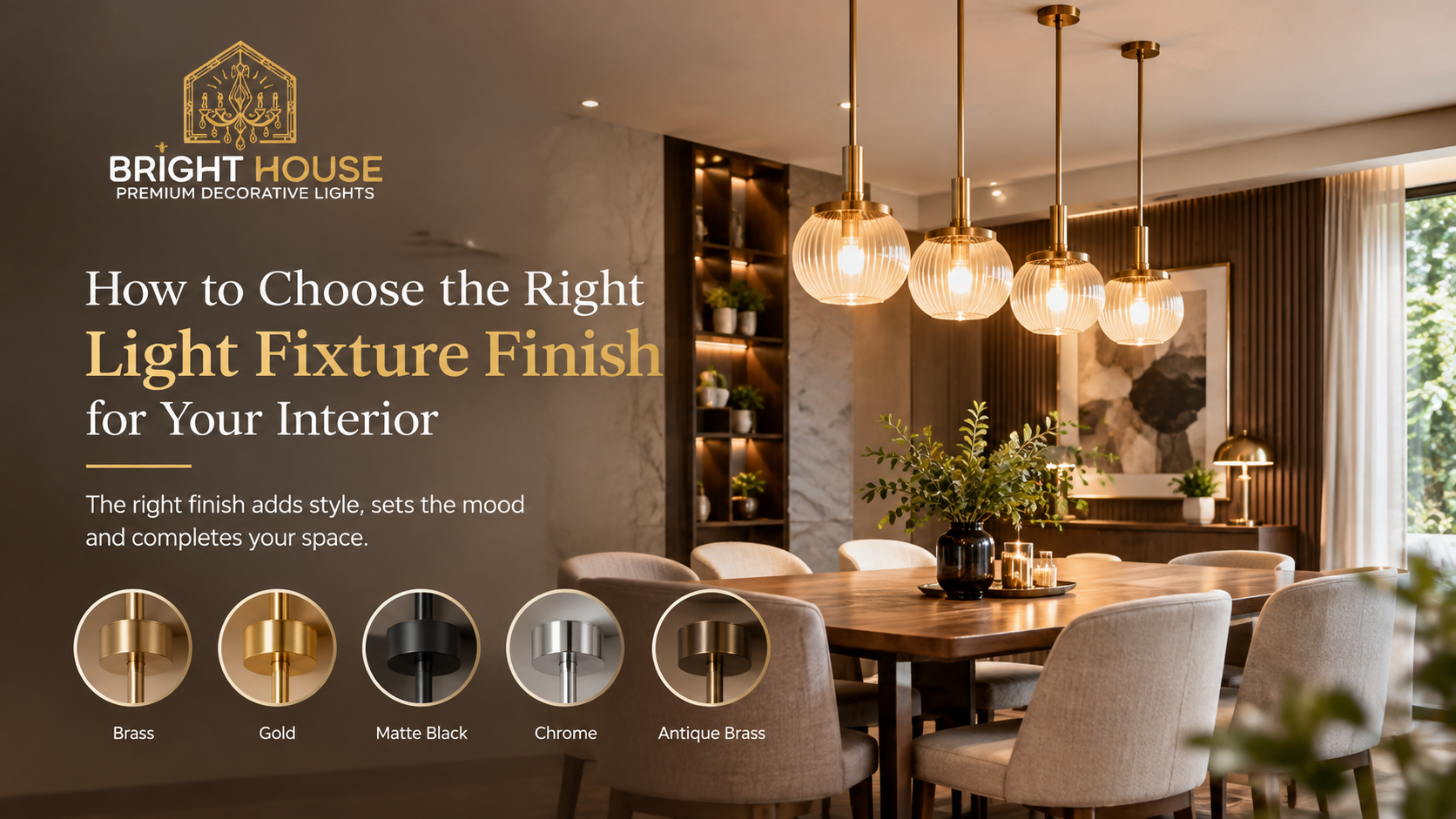
Downward facing shapes beat open globes over a dining table. A cone, dome or bell throws light onto the food and keeps the lamp out of the sightline, while a clear globe puts a bright source directly at seated eye level.
Shape also decides how low you can go. A shade that hides the bulb from the side can sit at the bottom of the clearance band, and a transparent one has to sit at the top of it.
- Cone and dome. The safest choice. Directs light down, hides the lamp, works at 75 cm.
- Bell and schoolhouse. Softer edge to the pool of light, good over a long table.
- Opal or milk glass. Glows without glare, and forgiving if the row hangs slightly uneven.
- Clear glass globe. Beautiful unlit, difficult lit. Use a low output filament lamp and hang high.
- Metal cylinder. Tight beam, dramatic, but leaves the ends of a long table dark.
Finish matters as much as form. A white or brass lined interior bounces light back down onto the table, where a black lined shade absorbs a surprising amount of it before anything reaches the food.
Ask for a colour rendering index of 90 or better while you are choosing. Below 80 the reds go flat first, which is exactly what makes a wooden table and a plate of food look dull under an otherwise correct lamp.
How Far Apart Should Pendant Lights Sit?
Space the shades 60 to 75 cm apart, centre to centre, and keep the outer two at least 15 cm inside the table edge. Spacing and dining table pendant light height are judged together, because shades hung close will crowd each other if they also hang low.
- Measure from the centre of one shade to the centre of the next, never edge to edge.
- Divide the table length into equal parts, then place a shade at each division point.
- Leave 15 cm of clear tabletop beyond the outer shade at both ends.
- Align the row to the centre line of the table, not the centre line of the room.
- Allow at least one shade diameter of clear air between neighbours.
The alignment rule is the one that catches people out. Builders in India place the dining point by convention rather than by furniture, so the table and the wiring rarely agree on where the centre is.
Where they disagree, get the points moved before the false ceiling closes. After that, a ceiling plate with swag hooks is the only honest fix.
Does Hanging Height Change How Bright The Table Feels?
Yes, and by more than most people expect. Light falls away with the square of the distance, so the same shade lights a table noticeably harder at 75 cm than at 90 cm, and the dining table pendant light height becomes a brightness decision as well as a visual one.
The physics is fixed. Illuminance drops with the square of the distance from the source, so doubling the gap between shade and tabletop leaves roughly a quarter of the light on it.
In the range that matters here, moving a shade from 90 cm down to 75 cm lifts the light landing on the table by around 40 percent, with no change to the bulb at all.
Plan 3,000 to 4,000 lumens in total over a six seater, split evenly across the row and run at 2700K. Three shades at 1,200 lumens each spread light across the whole surface, where one bright source burns a hot circle into the middle of it.
Put the row on a dimmer. A dining table needs to work at Sunday lunch and at nine in the evening, and a single fixed brightness only ever suits one of them.
How Do You Measure Before You Order?
Take four measurements and the dining table pendant light height stops being a judgement call. You need the ceiling height, the tabletop height, the table length, and the exact position of the existing ceiling point.
- Measure floor to finished ceiling, at the table rather than at the wall.
- Measure floor to tabletop, which is usually 75 cm but worth confirming.
- Subtract the tabletop height and your chosen clearance to find the maximum drop.
- Measure the table length and divide it by 60 to 75 cm to get the number of shades.
- Mark the ceiling points in chalk and stand back before anyone drills.
- Check the adjustable range of the fixture against the drop you calculated.
Step five costs nothing and prevents the most expensive mistake. Chalk marks seen from the doorway will tell you in ten seconds what a specification sheet never can.
Weight is worth confirming at the same time. A row of three glass shades on a shared canopy can pass four kilograms once the metalwork is included, and anything above about three kilograms needs an anchor drilled through the false ceiling into the concrete slab above it.
Do the night test before the canopy screws go tight. A row that looks perfect at three in the afternoon can glare straight back off a polished tabletop after dark, and moving a cable by 10 cm is a two minute job while the fitting is still loose.
A dining chandelier is the better answer if your table is round, under 120 cm, or sitting below a ceiling with only one usable point.
Frequently Asked Questions
How High To Hang Pendant Lights Over A Dining Table?
Between 75 and 90 cm above the tabletop, measured to the lowest point of the shade. Start at 80 cm on a 9 foot ceiling and adjust once the table is in place.
Does A Round Table Need A Different Height?
No. A round table uses the same dining table pendant light height, though a single wider fixture centred on the table usually suits it better than a row of small shades.
How Many Pendants Suit A Six Seater?
Two or three. A six seater is typically 150 to 180 cm long, which takes two shades of 25 to 30 cm or three of about 22 cm across.
Can Pendants Hang Off Centre Over A Table?
Only as a last resort. An off centre row is visible from every seat, so move the table or shift the ceiling points rather than hoping nobody notices.
What If There Is Only One Ceiling Point?
Use a multi light canopy or a linear bar that carries several shades from one fitting. Both give you a row without any new wiring or ceiling work.
Do Pendants Over A Table Need A Dimmer?
Yes, in practice. Table lighting has to serve bright daytime meals and low evening ones, and a dimmer is the cheapest way to get both from one purchase.
Where Should You Start Measuring?
Measure the table and the ceiling before you open a single product page. With those numbers fixed, the dining table pendant light height and the shade count decide themselves, and the shortlist shrinks to a handful of finishes.
Bring the measurements to our Bangalore showroom, where fixtures hang at working heights, and see the row lit above a real table before it ships.