Wood brings warmth, texture and character to a home, but poorly planned lighting can make wooden interiors feel darker, heavier and smaller than they actually are. This is especially noticeable with dark wood furniture, wooden wall panels, timber ceilings, cabinets and rich brown flooring.
The solution is not simply to add brighter bulbs. Good lighting for wooden interiors is about using the right combination of ambient, task and accent lighting, choosing suitable colour temperatures, and directing light where the wood needs it most.
Whether your home has a traditional wooden interior or a modern space with timber details, the right lighting can make the material look warm and refined without allowing the room to become visually dark.
What Is the Best Way to Light Wooden Interiors?
The best way to light wooden interiors is to combine layered lighting with warm but sufficiently bright LED sources, rather than depending on one ceiling fixture.
A practical lighting plan should include:
- Ambient lighting for overall visibility
- Task lighting for areas such as desks, kitchen counters and reading corners
- Accent lighting to highlight wood textures and architectural details
- Wall lighting to brighten vertical surfaces
- Concealed lighting for cabinets, shelves and wooden panels
- Dimmable fixtures for changing the atmosphere throughout the day
Wood absorbs and visually carries more warmth than white walls, so light distribution becomes particularly important.
A single downlight in the centre of a room may illuminate the floor while leaving wooden walls, cabinets and corners looking dark. By spreading light across different levels, you can make the entire interior feel brighter without making it harsh.
For more ideas about combining different lighting layers, see Bright House's room-by-room layered lighting guide.
Why Can Wooden Interiors Look Dark Even When the Room Has Enough Light?
Wooden interiors can look dark because the available light is concentrated in the wrong places rather than because the room necessarily lacks sufficient light.
Several factors contribute to this effect:
- Dark wood absorbs more visual attention. Rich walnut, teak and dark-stained finishes can make a room feel visually dense.
- Ceiling-only lighting leaves vertical surfaces dark. Walls and cabinets need their own illumination.
- Poor beam direction creates shadows. A downlight may illuminate the floor while leaving a wooden wall almost untouched.
- Cool lighting can flatten warm wood tones. Very cool white light may make brown and reddish finishes appear less inviting.
- Large uninterrupted wooden surfaces need visual breaks. Accent lighting can reveal grain and texture instead of allowing the surface to become one dark mass.
The goal is therefore not maximum brightness. The goal is balanced brightness.
Which Colour Temperature Works Best for Wooden Interiors?
For most residential wooden interiors, 2700K to 3000K warm white lighting is a practical starting point because it complements the natural warmth of timber.
A useful guide is:
| Colour temperature | Appearance | Suitable use |
|---|---|---|
| 2200K to 2500K | Deep, amber-like warmth | Decorative accents |
| 2700K | Warm and cosy | Bedrooms, living rooms, wood-heavy spaces |
| 3000K | Warm but clearer | General residential lighting |
| 3500K | Neutral | Functional contemporary areas |
| 4000K+ | Cool and crisp | Work-focused areas |
The U.S. Department of Energy explains that lower Kelvin values generally produce warmer-looking light, while higher values appear cooler. It also recommends considering lumens rather than wattage when comparing light output. U.S. Department of Energy lighting guide.
For a living room dominated by teak furniture and wooden wall panels, 2700K or 3000K can preserve the material's warmth. A home office with wood furniture may benefit from a slightly more neutral task light while keeping the surrounding ambient lighting warmer.
The important thing is consistency. Avoid randomly mixing a 2700K ceiling light with a very cool 5000K strip light on the same wooden feature wall.
How Should You Use Ambient Lighting in a Wood-Focused Room?
Ambient lighting should provide comfortable general illumination without making the ceiling fixture the only important source of light.
Good ambient options include:
- Flush ceiling lights
- Semi-flush fixtures
- Pendant lights
- Chandeliers
- Recessed downlights
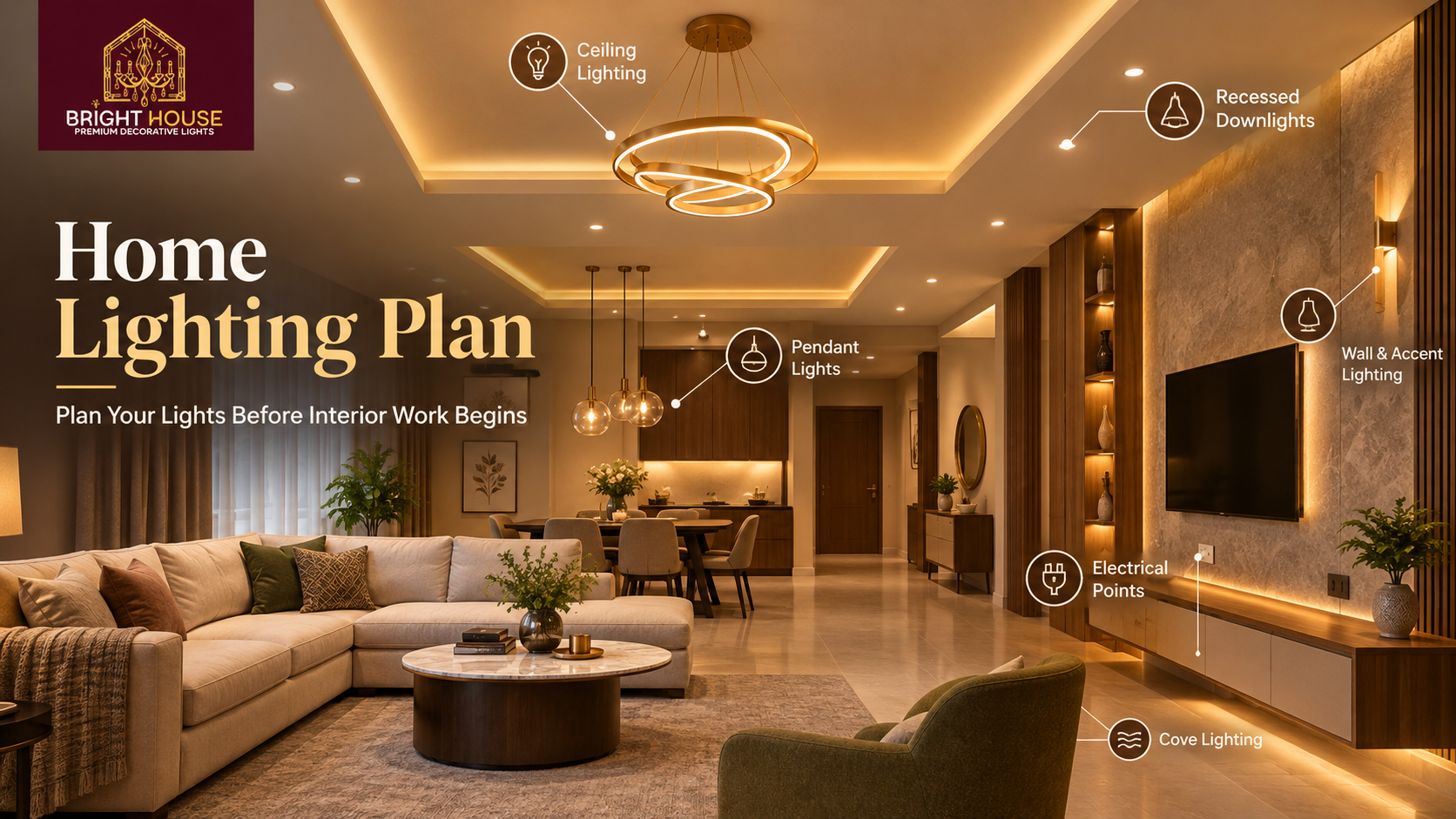
- Cove lighting
- Indirect ceiling lighting
For a room with substantial woodwork, indirect lighting can be particularly effective. Instead of pointing every light directly at the floor, use some light to brighten walls, ceilings or architectural surfaces.
For example, a wooden living room can use a central pendant for general illumination, wall lights for vertical surfaces and concealed LED lighting around a wooden TV unit.
This creates depth and prevents the furniture from appearing as a series of dark shapes.
For more living-room-specific planning, see Bright House's living room lighting ideas for Indian homes.
How Can Accent Lighting Make Wood Look Brighter?
Accent lighting can make wood look brighter by revealing its grain, texture and three-dimensional details.
Instead of washing an entire wooden wall with intense light, use focused sources to highlight selected areas.
Useful options include:
- Adjustable spotlights
- Wall washers
- Picture lights
- Concealed LED strips
- Recessed shelf lights
- Linear profile lights
- Directional track lights
For example, if a living room has a teak feature wall, two or three carefully positioned spotlights can reveal the grain without flooding the entire wall with excessive brightness.
The light should enhance the wood rather than create bright patches.
A simple accent-lighting formula
Wooden feature + controlled beam + suitable colour temperature = visible texture without excessive brightness.
This is especially useful for:
- Wooden TV panels
- Decorative wall cladding
- Carved partitions
- Wooden ceilings
- Display cabinets
- Bookshelves
- Wooden artwork frames
Should You Use LED Strip Lights on Wooden Walls and Cabinets?
Yes, concealed LED strip lighting can work very well with wooden walls, cabinets and shelves when it is installed carefully.
The most effective approach is usually to hide the light source rather than expose individual LED points.
You can install LED strips:
- Behind a wooden TV panel
- Under floating cabinets
- Beneath shelves
- Inside display units
- Along wardrobe interiors
- Behind a wooden headboard
- Inside kitchen cabinets
- Along architectural niches
A diffuser or suitable aluminium profile can help create a smoother appearance and reduce visible hotspots.
For dark wood, avoid making the strip extremely bright. The objective is to create a soft layer of illumination that separates the wooden surface from the surrounding wall.
How Do You Light a Dark Wooden Ceiling?
A dark wooden ceiling needs careful lighting because placing bright downlights directly across it can create an uneven pattern of spots and shadows.
A better approach is to combine general and indirect illumination.
Consider:
- Wall washing: Direct some light toward the walls so the room does not depend entirely on ceiling illumination.
- Pendant lighting: Use a decorative pendant to bring the main light source lower into the room.
- Recessed spotlights: Use fewer directional fixtures and aim them toward important areas.
- Cove lighting: If the ceiling design permits it, concealed light around the perimeter can create a soft glow.
- Wall lights: Add illumination at a lower level to balance the dark ceiling.
If the ceiling is heavily patterned or made from rich timber, avoid installing a dense grid of downlights. Too many visible light points can compete with the natural character of the wood.
What Is the Best Lighting for Wooden Furniture?
The best lighting for wooden furniture depends on whether the furniture is being used for a task, displayed as a feature or simply forming part of the room.
| Wooden element | Recommended lighting | Main purpose |
|---|---|---|
| Wooden sofa table | Table lamp or pendant | Soft local illumination |
| Wooden dining table | Pendant or chandelier | Dining and visual focus |
| Wooden cabinet | Internal LED or spotlights | Display and visibility |
| Wooden bookshelf | Concealed LED strips | Shelf illumination |
| Wooden bed | Bedside lamps or wall lights | Comfortable bedroom lighting |
| Wooden TV unit | Backlighting or concealed LED | Depth and visual balance |
| Wooden study desk | Adjustable task light | Focused work |
| Wooden partition | Wall washing or spotlights | Highlight texture |
The fixture should support the furniture rather than overwhelm it.
For example, a large decorative chandelier above a small wooden dining table can make the space feel crowded, while a slim pendant may provide enough light and preserve the visual simplicity of the furniture.
How Can You Light Wooden Walls Without Making Them Look Flat?
Wooden walls look more interesting when the lighting creates gentle variations in brightness across the surface.
Use directional or grazing light when you want to emphasise:
- Wood grain
- Carved details
- Vertical slats
- Fluted panels
- Natural texture
- Architectural joints
- Decorative patterns
However, grazing light should be controlled carefully. If the light source is too close to an uneven surface, every small imperfection can create strong shadows.
For smoother wood panels, a broader wall-washing effect can create a more even appearance.
For heavily textured or carved wood, directional lighting can be used to bring out depth.
The right technique depends on the surface rather than simply the type of wood.
How Important Is CRI for Wooden Interiors?
CRI is important because it affects how naturally wood, fabrics, artwork and decorative finishes appear under artificial light.
CRI, or Colour Rendering Index, indicates how accurately a light source reveals colours compared with a reference source.
For wood-heavy interiors, consider good-quality LEDs with a CRI of 80 or above for general residential applications. CRI 90 or higher can be particularly useful where you want wood grain, artwork, textiles and decorative colours to appear more naturally.
This matters because two lights with similar brightness and colour temperature can still make the same wooden furniture look different.
Bright House's CRI guide for home lighting explains how colour rendering affects wood, artwork, fabrics and other interior finishes.
How Many Lights Does a Wooden Room Need?
There is no universal number because the required lighting depends on room size, ceiling height, natural daylight, wall colour, furniture and the type of wood used.
Instead of counting fixtures, divide the room into lighting zones.
| Zone | Lighting layer | Example |
|---|---|---|
| Main room | Ambient | Ceiling light or pendant |
| Wooden feature wall | Accent | Spotlight or wall washer |
| Seating area | Task/local | Floor or table lamp |
| Cabinets | Accent | Concealed LED |
| Reading area | Task | Adjustable reading light |
| Corners | Secondary ambient | Wall light or floor lamp |
This approach gives you much more control than installing several identical downlights.
A 150 sq ft room, for example, might feel better with several moderately bright sources distributed throughout the space than with one extremely bright ceiling fixture.
How Can You Make a Small Wooden Room Look More Spacious?
A small wooden room can appear more spacious when lighting is distributed across walls, furniture and ceiling surfaces.
Try these techniques:
- Use wall lights to brighten vertical surfaces.
- Add concealed lighting behind wooden panels.
- Use a slim pendant rather than an oversized chandelier.
- Illuminate shelves instead of leaving them completely dark.
- Keep the main colour temperature consistent.
- Use dimmers to control brightness according to the time of day.
- Avoid excessive dark fixtures in already wood-heavy spaces.
- Use reflective surfaces selectively to distribute available light.
The key is to prevent all the visual weight from sitting at floor level.
When walls and ceiling surfaces receive some illumination, the room can feel more balanced.
What Lighting Mistakes Should You Avoid With Wooden Interiors?
1. Using only one ceiling light
A single fixture often leaves wooden walls and furniture in shadow.
Better approach: Add wall, task and accent lighting.
2. Using excessively cool light
Very cool light can make a warm wood interior feel visually disconnected.
Better approach: Start with 2700K to 3000K for most residential areas.
3. Installing too many downlights
A grid of bright downlights can create glare and distracting pools of light.
Better approach: Use directional fixtures only where they serve a purpose.
4. Making concealed LEDs too bright
Extremely bright strips can turn decorative lighting into the dominant feature.
Better approach: Use concealed lighting as an accent layer.
5. Ignoring the wood grain
Flat lighting can make beautiful woodwork look visually plain.
Better approach: Use controlled directional lighting to reveal texture where appropriate.
6. Mixing colour temperatures randomly
Different white tones can make the same room feel visually inconsistent.
Better approach: Keep connected lighting zones within a coordinated colour-temperature range.
7. Choosing bulbs only by wattage
Wattage indicates electrical consumption, not simply how much visible light a fixture produces.
Better approach: Compare lumens, colour temperature, CRI, beam angle and dimming compatibility.
What Is a Practical Lighting Plan for a Wooden Indian Home?
For a typical Indian home with wooden furniture, cabinets or feature walls, a simple layered plan can work across several rooms.
| Room | Ambient lighting | Accent/task lighting |
|---|---|---|
| Living room | Pendant, chandelier or ceiling light | Wall lights, spots, floor lamp |
| Bedroom | Warm ceiling light | Bedside lamps, headboard LED |
| Dining room | Pendant or chandelier | Cabinet or wall accents |
| Kitchen | Ceiling lighting | Under-cabinet task lighting |
| Home office | Ceiling or indirect light | Desk lamp and shelf lighting |
| Pooja room | Warm ceiling light | Mandir spotlight and concealed LED |
| Home library | Soft ceiling light | Reading lamp and shelf lighting |
For a wooden home interior, the most important principle is to avoid asking one fixture to perform every lighting function.
Use one layer for visibility, another for activities and another for atmosphere.
How Can You Create a Warm Wooden Interior at Night?
At night, reduce dependence on the central ceiling fixture and allow smaller sources to create the atmosphere.
A comfortable evening setup could include:
- Warm ambient ceiling lighting at reduced brightness
- A floor lamp beside the sofa
- Concealed lighting behind a wooden TV panel
- Small wall lights on feature walls
- Under-shelf lighting
- A focused pendant over the dining table
- Bedside lamps in bedrooms
This approach allows the wood to remain the visual character of the room without turning the entire space into a dark brown background.
Dimmers or separate switches are particularly useful because the same room may need different lighting levels for cleaning, entertaining, dining, reading and relaxing.
Final Checklist for Lighting Wooden Interiors
Before finalising your lighting plan, check the following:
-
Is the main room sufficiently illuminated?
-
Are wooden walls receiving some light?
-
Are dark corners addressed?
-
Is the colour temperature coordinated?
-
Are important wooden features highlighted?
-
Are LED strips concealed or diffused where necessary?
-
Is the lighting comfortable rather than glaring?
-
Have you considered CRI?
-
Are task areas separately illuminated?
-
Can the brightness be adjusted?
-
Are fixtures correctly sized for the room?
-
Does the lighting complement rather than overpower the wood?
The best lighting for wooden interiors does not try to remove the warmth of wood. Instead, it uses light to reveal that warmth, add depth and prevent darker surfaces from dominating the room.
Start with layered lighting, choose a suitable warm-white colour temperature, illuminate vertical surfaces and use accent lighting selectively. With the right balance, even a room filled with dark timber, teak furniture or wooden wall panels can feel bright, comfortable and visually sophisticated.
Frequently Asked Questions
1. What is the best colour temperature for wooden interiors?
Warm white lighting between 2700K and 3000K is a practical choice for most wooden residential interiors. It complements the natural warmth of timber while providing comfortable illumination.
2. How do you brighten a room with dark wood?
Use multiple lighting layers instead of one bright ceiling fixture. Add wall lights, concealed LEDs, floor lamps, task lighting and focused accent lights to distribute illumination around the room.
3. Are LED strip lights suitable for wooden interiors?
Yes. Concealed LED strips work particularly well under shelves, behind TV panels, inside cabinets and around wooden architectural features. Diffusers can help create a smoother appearance.
4. What CRI should I choose for wooden interiors?
CRI 80 or above is a useful starting point for general home lighting. CRI 90 or higher can be valuable when accurate colour appearance is important for wood, artwork, fabrics and decorative finishes.
5. Can dark wood interiors use 3000K lighting?
Yes. 3000K provides warm white illumination while appearing slightly clearer than 2700K. It can work particularly well in modern interiors with dark wood and neutral finishes.