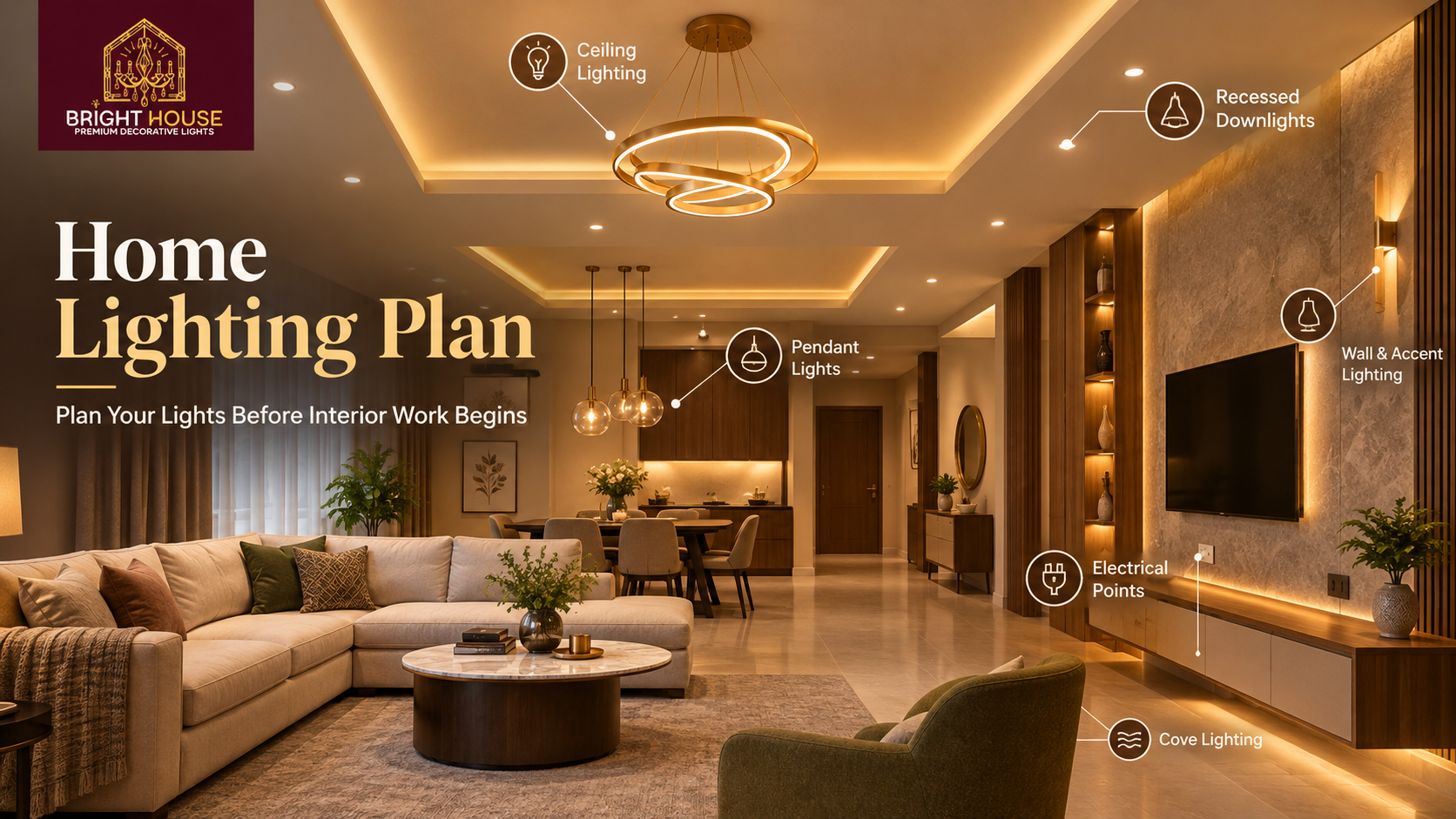
A pooja room is more than another space in the home. It is a place for prayer, reflection and quiet moments, so the lighting should feel comfortable, warm and intentional.
The right pooja room lighting ideas can highlight the mandir, bring attention to decorative details and create a welcoming atmosphere without making the room feel overly bright. Instead of relying on one powerful ceiling light, a combination of ambient, focused and accent lighting can create better depth and visual comfort.
Warm white lighting, carefully positioned LED fixtures, concealed illumination and decorative wall lights are some of the options that can work well in a pooja room.
In this guide, we explore practical ways to choose pooja room lights, decide where to place them and combine traditional and modern lighting styles.
What Are the Best Pooja Room Lighting Ideas for a Peaceful Home?
The best approach is to use warm, layered lighting that illuminates the mandir without creating harsh glare.
A simple pooja room lighting plan can include:
- A soft ceiling light for general illumination
- Focused light around the deity or mandir
- Concealed LED lighting around niches or shelves
- Decorative wall lights for additional warmth
- Dimmable lighting for different times of day
- Warm white LED sources for a comfortable atmosphere
Bright House's dedicated guide to pooja room lighting, fixture placement and warmth also recommends using multiple lighting layers rather than depending on one bright fixture.
The objective is simple: the mandir should remain visually important while the surrounding room stays softly illuminated.
Which Colour Temperature Is Best for Pooja Room Lighting?
Warm white lighting between approximately 2700K and 3000K is a practical choice for a pooja room because it creates a softer and more comfortable atmosphere.
Colour temperature has a significant effect on the appearance of a space.
Cool white lighting can make a room feel brighter and more clinical, while warm white light can create a softer appearance that works particularly well with wood, brass, gold, marble and traditional decorative finishes.
Colour temperature guide
| Colour temperature | Appearance | Suitable use |
|---|---|---|
| 2700K | Warm and soft | Prayer and evening use |
| 3000K | Warm white | General pooja room lighting |
| 3500K | Neutral | Contemporary interiors |
| 4000K+ | Cool/neutral white | Functional areas where brighter light is needed |
For a traditional or luxury mandir, 2700K to 3000K can complement brass, wooden carvings and warm-toned interiors particularly well.
The most important point is consistency. If the ceiling light is warm but a nearby LED strip is noticeably cool, the two sources can make the space feel visually disconnected.
How Should You Light the Main Mandir?
The deity or central mandir should receive focused illumination from the front or sides rather than strong light directly from behind.
This helps reveal the details of the idol, backdrop and decorative elements.
For a wall-mounted or built-in mandir, concealed LED strips can be installed around niches or architectural details. Small directional fixtures can then provide additional illumination where needed.
Consider these options:
- Focused LED lighting for the central deity
- Concealed LED strips around niches
- Small spotlights for decorative elements
- Warm wall lights on either side of the mandir
- A decorative pendant where ceiling height allows it
Avoid placing a very bright exposed light directly in the line of sight. The goal is to illuminate the space without creating uncomfortable glare.
What Are the Best Pooja Room Ceiling Lights?
The best pooja room ceiling light depends on the room's size, ceiling height and interior style.
A compact pooja room may only require a small flush or surface-mounted ceiling light. A larger dedicated prayer room can accommodate a decorative pendant, compact chandelier or multiple ceiling fixtures.
Ceiling light options
| Fixture | Best suited for | Main benefit |
|---|---|---|
| Flush ceiling light | Small pooja rooms | Compact and practical |
| LED panel | Functional spaces | Even general illumination |
| Pendant light | Higher ceilings | Decorative focal point |
| Compact chandelier | Larger pooja rooms | Luxury appearance |
| Recessed spotlight | Mandir niches | Focused illumination |
| Concealed LED | Shelves and niches | Soft decorative glow |
When selecting pooja room ceiling lights, remember that the ceiling fixture does not need to provide all the illumination. Combining it with accent lighting often creates a more balanced result.
Bright House's guide to layered lighting explains how ambient, task and accent lighting can be combined to create more depth and flexibility.
Are LED Lights Good for a Pooja Room?
Yes. LED lights are a practical choice for pooja rooms because they are available in different colour temperatures, brightness levels and fixture formats.
LED lighting can be used for:
- Ceiling fixtures
- Recessed lights
- Spotlights
- Cove lighting
- Backlighting
- Shelf lighting
- Decorative fixtures
- Wall lights
For a mandir, the quality of the light matters as much as brightness. Look for fixtures with suitable colour rendering so that brass, wood, stone, fabric and decorative details appear natural.
LED lighting also makes it easier to create multiple lighting layers without filling the ceiling with large fixtures.
How Can You Use Concealed LED Lighting in a Pooja Room?
Concealed LED lighting can create a soft glow around the mandir without making the light source visually dominant.
This is particularly useful in contemporary pooja rooms where clean lines and minimal fixtures are part of the design.
You can install concealed lighting:
- Behind a carved mandir panel
- Around a recessed niche
- Under a shelf
- Behind a decorative back panel
- Along the edges of a ceiling feature
- Beneath a platform or cabinet
- Around architectural borders
The light should generally enhance the design rather than become the main visual feature.
For example, a warm LED strip behind a wooden mandir panel can create a subtle halo effect. A concealed light beneath a shelf can also highlight decorative objects without requiring another visible fixture.
What Are the Best Small Pooja Room Lighting Ideas?
Small pooja rooms benefit from compact fixtures, concealed lighting and carefully directed illumination.
When space is limited, avoid filling the ceiling with multiple large fixtures.
Instead, consider:
- One compact ceiling light
- Two small directional lights
- Concealed LED strips
- Small wall sconces
- A backlit mandir panel
- Warm accent lighting
A small room does not necessarily need less lighting. It needs better-controlled lighting.
Using different layers can make a compact pooja room feel more detailed without making it visually crowded.
Small pooja room lighting example
| Area | Suggested lighting |
|---|---|
| Ceiling | Compact warm LED fixture |
| Mandir centre | Focused spotlight |
| Back panel | Concealed LED |
| Shelves | Under-shelf LED |
| Side walls | Small decorative sconces |
How Can Wall Lights Improve Pooja Room Lighting?
Pooja room wall lights can add a decorative layer while creating softer illumination around the mandir.
Wall lights work particularly well when placed symmetrically on either side of a central mandir.
Depending on the design, they can provide upward, downward or diffused illumination.
Choose a fixture that complements the mandir's material and style.
For example:
- Brass wall lights work well with traditional interiors.
- Minimal metal sconces suit contemporary mandirs.
- Glass fixtures can provide soft diffusion.
- Decorative carved fixtures can complement wooden mandirs.
Bright House's wall light height guide recommends approximately 165 to 175 cm from the finished floor to the centre of a general wall fitting, although the final position should be adjusted for the fixture, furniture and sightlines.
For a pooja room, the mandir's height and viewing position should also be considered.
Should Pooja Room Lighting Be Warm or Cool?
Warm lighting is generally more suitable when the goal is a calm, welcoming and traditional atmosphere.
Warm light can work especially well with:
- Wooden mandirs
- Brass diyas
- Gold finishes
- Marble
- Natural stone
- Beige and cream interiors
- Traditional carvings
Cooler lighting can have a place in contemporary interiors, but it should be selected deliberately.
If the room contains several fixtures, try to keep their colour temperatures coordinated. A warm central light combined with a noticeably blue-toned accent strip can make the room look inconsistent.
How Can You Combine Traditional and Modern Pooja Room Lighting?
Combine traditional decorative fixtures with modern LED technology to create a balanced lighting scheme.
A traditional mandir does not require traditional technology.
For example, you could combine:
- A brass decorative wall light
- Warm LED spotlights
- Concealed LED backlighting
- A modern dimmable ceiling fixture
- Traditional diyas during prayer
This approach preserves the visual character of the pooja room while providing more control over brightness and illumination.
Traditional vs modern lighting
| Traditional approach | Modern approach |
|---|---|
| Brass lamps | Integrated LED fixtures |
| Decorative sconces | Minimal wall lights |
| Oil lamps | Dimmable LED lighting |
| Ornamental ceiling fixtures | Recessed spotlights |
| Carved wooden details | Concealed LED strips |
The two styles can work together rather than being treated as alternatives.
How Should You Light a Pooja Room for Morning and Evening Prayer?
Use flexible lighting so the room can feel bright enough for daytime activities and softer during evening prayer.
During the day, natural light may provide much of the room's illumination. In the evening, a combination of ambient and accent lighting can create a more intimate environment.
A dimmer can be particularly useful if the fixtures and electrical system support compatible dimming.
A simple two-mode lighting plan
Morning
- Moderate ceiling illumination
- Focused mandir light
- Natural daylight where available
Evening
- Lower ambient brightness
- Warm mandir accent lighting
- Concealed LED glow
- Decorative wall lights
This makes the same room adaptable without requiring different fixtures for different times.
How Many Lumens Does a Pooja Room Need?
A practical starting point is around 20 to 25 lumens per square foot for ambient lighting, with additional focused light at the mandir.
For example, Bright House's room-by-room lumens guide lists a 25 sq ft pooja room at approximately 500 to 625 lumens for ambient lighting, with additional task illumination at the mandir.
| Pooja room size | Approximate ambient lighting |
|---|---|
| 16 sq ft | 320 to 400 lumens |
| 20 sq ft | 400 to 500 lumens |
| 25 sq ft | 500 to 625 lumens |
| 40 sq ft | 800 to 1,000 lumens |
| 50 sq ft | 1,000 to 1,250 lumens |
These figures are starting points rather than strict fixture specifications. The amount of daylight, wall colour, ceiling height, fixture efficiency and desired atmosphere can all change the final requirement.
What Lighting Mistakes Should You Avoid in a Pooja Room?
Several common mistakes can reduce the comfort and visual quality of a mandir.
1. Using only one bright ceiling light
One powerful light can flatten the space and create harsh shadows.
Better approach: Combine ambient lighting with focused and accent lighting.
2. Choosing very cool light
Cool white lighting may not complement warm wood, brass or traditional finishes.
Better approach: Consider 2700K to 3000K for a warmer appearance.
3. Creating glare around the deity
A bright exposed source can make it uncomfortable to look toward the mandir.
Better approach: Use concealed, diffused or carefully directed fixtures.
4. Ignoring the mandir's proportions
A large chandelier can overwhelm a compact pooja room.
Better approach: Match fixture size to the room and mandir.
5. Installing too many lights
More fixtures do not automatically produce better lighting.
Better approach: Decide what each fixture is supposed to illuminate before installing it.
6. Mixing unrelated colour temperatures
Different shades of white can make the room feel visually inconsistent.
Better approach: Keep the lighting scheme coordinated.
How Do You Choose the Right Pooja Room Light Design?
Choose the light design according to the mandir's architecture, room size, materials and overall interior style.
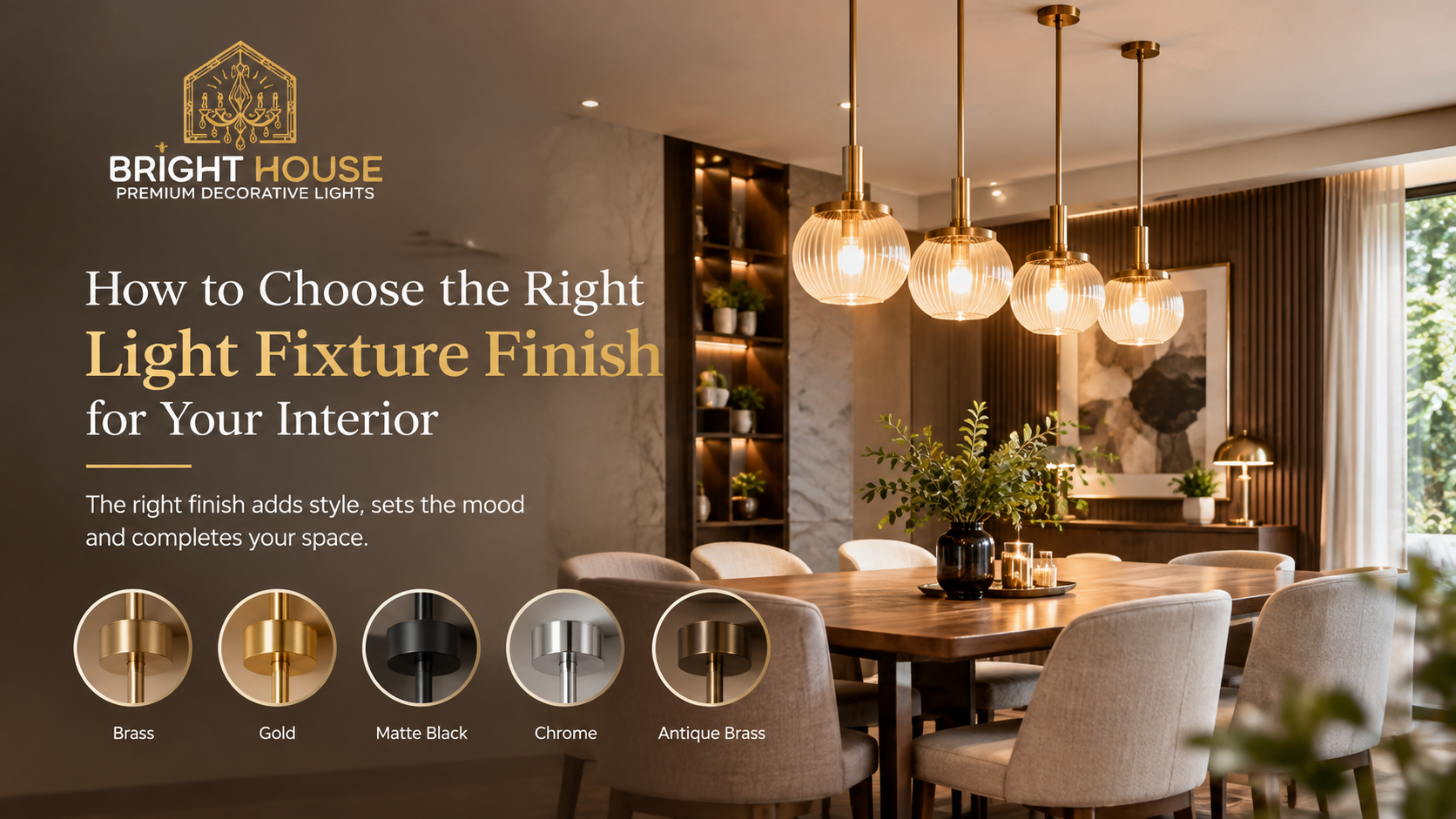
For traditional homes, consider brass, glass, carved or ornamental fixtures.
For modern homes, consider:
- Minimal pendant lights
- Recessed LEDs
- Slim wall lights
- Geometric fixtures
- Concealed LED profiles
- Integrated LED ceiling lights
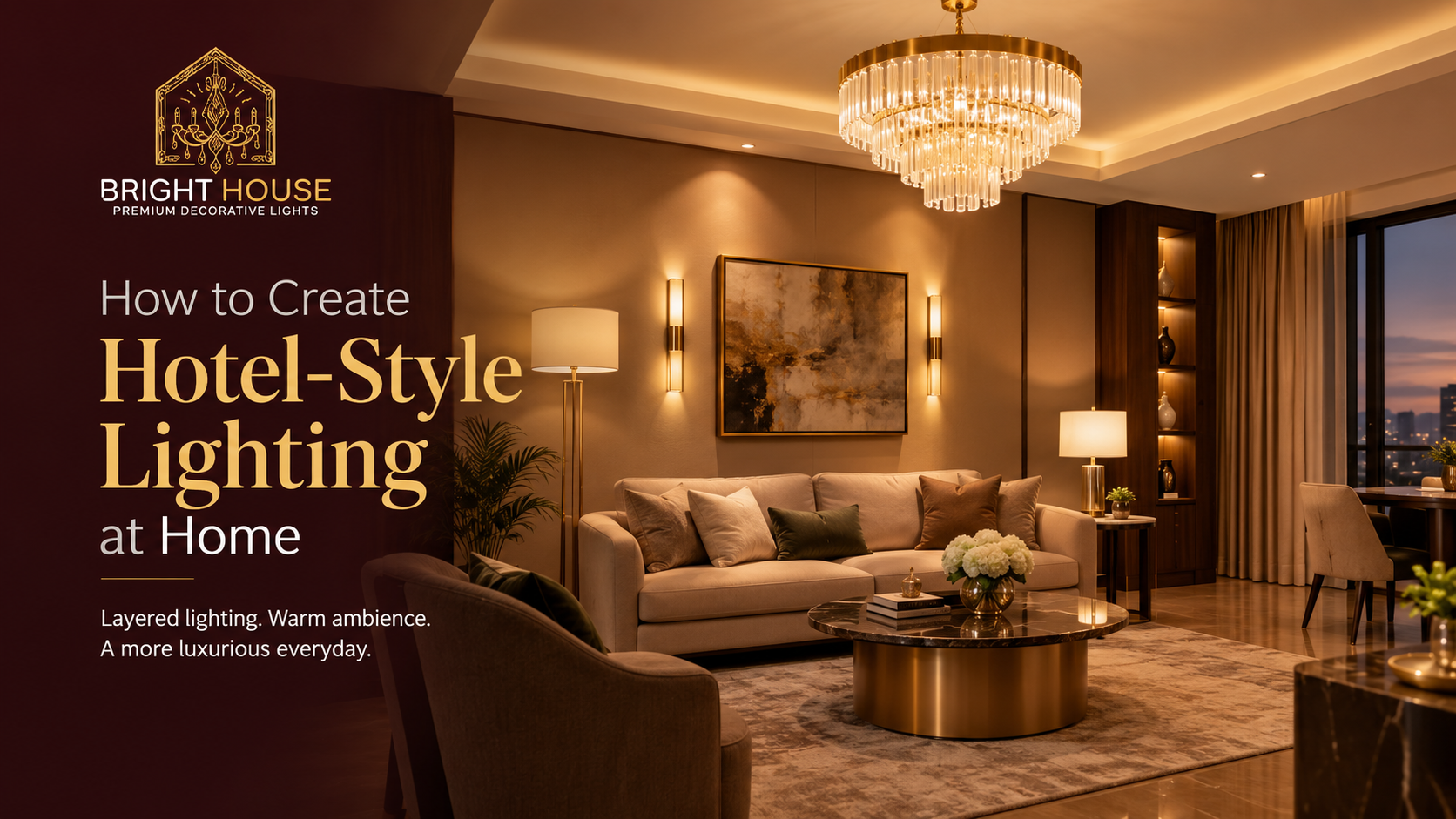
For luxury interiors, decorative chandeliers and sculptural fixtures can become focal points, provided the room has enough ceiling height and the fixture is appropriately scaled.
Bright House's guide to different chandelier styles explains how fixture type, ceiling height, room and material influence chandelier selection.
Pooja Room Lighting Ideas: Quick Selection Guide
| Pooja room requirement | Recommended lighting |
|---|---|
| Small mandir | Compact ceiling light + focused LED |
| Traditional mandir | Warm LED + brass wall lights |
| Modern mandir | Recessed LED + concealed lighting |
| Large prayer room | Ceiling fixture + wall lights + accent lighting |
| Wooden mandir | Warm concealed LED |
| Marble mandir | Warm spotlights + subtle backlighting |
| Low ceiling | Flush or compact ceiling light |
| High ceiling | Pendant or decorative chandelier |
| Mandir niche | Focused spotlight + concealed LED |
| Evening prayer | Warm, dimmable accent lighting |
Final Thoughts
The right pooja room lighting ideas are not about making the space as bright as possible. They are about creating a balanced environment where the mandir remains the visual focus and the surrounding space feels comfortable.
Start with warm white lighting, then build the scheme around the room's architecture. Use a ceiling fixture for general illumination, focused light for the deity and concealed or decorative lighting for depth.
For a small mandir, keep the fixtures compact. For a larger prayer room, consider multiple layers. Traditional homes can combine brass and ornamental fixtures with modern LED technology, while contemporary interiors can benefit from recessed and concealed lighting.
Most importantly, plan the lighting before finalizing the electrical points. Consider the mandir's size, ceiling height, materials, furniture and viewing angles together.
A thoughtfully planned lighting scheme can make a pooja room feel warm, elegant, peaceful and connected to the rest of the home, while still giving the mandir the attention it deserves.
Frequently Asked Questions
1. What is the best lighting for a pooja room?
Warm white LED lighting around 2700K to 3000K is a practical choice. Combine a soft ambient source with focused lighting around the mandir and concealed accent lighting where appropriate.
2. Which LED light is best for a pooja room?
Choose a quality LED fixture with a warm colour temperature, suitable brightness and good colour rendering. The fixture should also suit the size and design of the mandir.
3. Is warm white or cool white better for a pooja room?
Warm white is generally a better starting point for a peaceful and traditional atmosphere. Around 2700K to 3000K works particularly well with wood, brass and warm interior finishes.
4. Can I use LED strip lights in a pooja room?
Yes. LED strips can be used for concealed backlighting, shelves, niches and architectural details. They are particularly useful when you want a soft glow without a visible light source.
5. How many lights should a pooja room have?
There is no fixed number. A small room may need one ambient fixture and one or two focused sources, while a larger room may benefit from several lighting layers.